In the comments below, Erika Dreifus points us to Jeffrey Goldberg's top-notch post on Allison Benedikt's article, Benedikt having provided a somewhat random and apparently unappreciated shout-out to Goldberg that implies that he's somehow behind her. Which made me think how, while I agree with every bit of Goldberg's response to this, I'd just recently disagreed with another post of his. And yes, there's a connection. Namely: what is the relationship, if any, between Jewish intermarriage and Jewish anti-Zionism? Because we have, on the one hand, Benedikt, who ties together her disillusionment with Israel with her discovery of non-Jewish guys. On the other, Goldberg, who, though by no means a rah-rah Zionist, is more squarely on the friend-of-Israel end of things... and he just got through saying that a Jewish man who dates or marries out probably has messed-up ideas re: Jewish women, and is not manly enough to take them on.
Where to begin, from all the various Gender and Jewish Studies angles. We have the machismo of Zionism, from Nordau's Jewry of Muscle down to the heartthrob IDF soldiers they put on the Birthright buses, just to make the Diaspora dudes look extra-pasty. We have the stereotype of Jewish men as mama's-boys, making the ones with a "shiksa" (because yes, the year is 1959) rebellious real men. But I digress.
Some of the negative responses to Benedikt's essay - but not, to his credit, Goldberg's - have treated her having married out and her disillusionment with Zionism as of a piece, and have condemned both in the same breath. Benedikt herself encourages this, attributing her shift from rah-rah Zionism to anti-Zionism to some Gentile gentlemen who'd courted her, and in doing so, opened her eyes to the fact that OMG Israel isn't perfect.
For the intelligent reader, the questions to ask regarding the "romantic" part of the essay are: 1) why is this woman so dependent on dudes she's romantically involved with to tell her what to think about world affairs? and 2) why does she put up with her husband acting like an ass? And indeed, some responses get at this.
But for the not-so-sharp reader with knee-jerk inclinations in a direction diametrically opposed to Benedikt's, the moral of the story is, here's a nice Jewish girl lost to intermarriage. See, this is what happens when a Jew marries out.
Out-marriers deserve neither the credit nor the blame for having broken free of the confines of the American Jewish Establishment. We ought to think of intermarriage more as the result of assimilation (or, if you prefer, integration, or if you prefer an in-depth discussion of these terms, the introduction to my dissertation) than as an intentional act of assimilation.
But there's a sense among some Jews that marrying out is a kind of political statement, that it's an act undertaken in order to break from the community. By "among some Jews," I mean both some Jews who oppose intermarriage and some who are themselves intermarried. The former think of intermarriage as an act of aggression against the dwindling Jewish people, the latter consider it an extra-nice piece of evidence that one is not some kind of sheep, following everything they were told at Hebrew school, and that, as such, marrying out is of a piece with opposing The Zionist Oppressor.
Historically - as in, from "Portnoy" on - it's been Jewish men who've taken this approach to retroactively ascribing meaning to their inter-ethnic romances. Benedikt's foray into originality is to be a Jewish woman stricken with this neurosis. As Benedikt describes it, dating or better yet, marrying a "goy" comes from the same place as questioning Israel's right to exist. Or, as I suspect this actually went down, Benedikt happened to get together with this one guy Mark, then another, John, and has retroactively attributed this to a coherent (well, coherent-ish) Life Narrative.
Here's how to better reconcile all this: Two things are happening simultaneously. American Jews are interacting far more than ever before with our non-Jews neighbors, and Israel is coming to seem more and more distant to American Jews (who did not happen to have bizarre epiphanies about the Dreyfus Affair their senior years of college). These two things are related, insofar as, if you feel very comfortable in America, if one of your own parents isn't or wasn't brought up Jewish, you're likely to feel less of a connection to the Jewish state. The same factors that, for this population generally, lead to more Jews marrying out are also leading to fewer Jews feeling terribly pro-Israel.
The way these two shifts are not related, however, is that, while individual American Jews (like everyone else) get to decide, on the basis of whichever mix of evidence and emotion, what to think about the Israeli-Palestinian conflict, we (like individuals in all other communities) don't get to decide how integrated a world we're born into, which schools our parents will send us to, and how open members of other communities we meet will be to dating or marrying us. People do not marry who they marry to make a point. Most of us can only stand so many people for so long, and when we find someone we actually want to spend that much time with, and when it's mutual, we do not sneeze at this. Once we're under the you-choose system of spousal selection, as opposed to, here's your second cousin, be fruitful and multiply, it becomes very, very difficult to reject the possibility of a marriage to someone you know you can and want to be with for the rest of your life. (Remember, the yuppies of today aren't divorcing like they used to.) Thus you'll find Jews highly suspicious of Zionism, highly critical of the American-Jewish "establishment," married to other Jews, as well as Jews who are full-on Zionists - critical, perhaps, of Israeli policies, but overall pro-Jewish-state - married to non-Jews. Not because members of either group are hypocrites, but because spousal selection and politics are not the same thing.
Granted, it's not that people just up and wake up married to whomever. Jews who, though super-duper-integrated, care about raising at least nominally religiously-Jewish children, might well encourage their future spouses to convert. Other highly-integrated Jews might care more about Zionism (yes, we're out there), making a potential spouse's views on Israel more of a potential deal-breaker.* Either way, however, we're left with the fact that integrated Jews these days do not, as did those of a previous generation, arrive at young adulthood with a sense of Jews and Gentiles coming from totally different worlds. Whereas it once required extra effort to marry out, it now requires that, if anything, to marry in. The generations before us did not nobly reject the possibility of non-Jewish partners. This simply wasn't done in those days. (With all kinds of historical caveats I won't get into here.)
*Remember - and Benedikt's essay does not hint at this - that there are non-Jews at various points on the neutral-to-Zionist spectrum as well. If anything, because those who did not grow up Jewish don't associate Zionism with that-which-I-was-made-to-believe-as-a-child, if they're less emotional in rejecting Zionism, they're perhaps also less so in accepting it, if that's the route they go down. Which in a sense, even though I grew up plenty ethnically/culturally Jewish, describes my own experience. I was not sent to Zionist indoctrination summer camps, and don't remember having given much thought to Israel before or after my family toured it on a bus with other Americans when I was 8. That is, until I read Herzl, etc., in college. So I don't really associate Zionism with pleasing my family, doing what I'm told. So it's likely that a Jew more pro-Israel than postadolescent Benedikt would be put off by a guy like John's continuous anti-Israel scream-fest, and would have opted instead for someone else, not necessarily for someone Jewish. It's important to remember that this John, going by the essay, is rude, anti-Israel, and non-Jewish, and that these three things are basically unrelated.
Saturday, June 18, 2011
Intermarriage and (anti-) Zionism

Friday, June 17, 2011
Organic yoga arugula Park Slope strollers
It's obviously only a matter of time until the NYT allows comments - and comments there shall be - on this Styles article that hits, oh, just about every possible Styles mark: coastal, upper-middle-class, well-educated, blah blah, couples who divorce, in an era when only the plebs are supposed to do that. Bad parenting, in this post-post-post-"Mad Men"-era society! Where there were Styles clichés left out, author Carrie Bradshaw - no, Pamela Paul - threw them back in, adding "yoga" and "organic" for good measure. Oh, and of course, those profiled come across on a superficial level as saints, but between the lines as privileged fools. You know what? I don't believe there's a "Pamela Paul." I think this was some excellent work on the part of the paper's Style Article Generator.
Anyway, I've taken the bait. (Maybe I'm homesick, who knows. No Park Slope parenting in Paris. Still very much try-not-to-drop-the-cigarette-ashes-onto-the-head-of-the-kid-in-the-stroller in these parts.) So:
-Obviously, you don't know the personal business of the other playgroup parents, so yoga moms, fine, should not be so judgey of the few among them who divorce. Maybe there was nastiness behind the organic-sustainable curtains that you don't know about, and the split really did have to happen. But even if not, even if the parents divorced for no good reason, for god's sake be civil with acquaintances.
-But maybe it is reasonable that people are judgey about divorce when there are young kids involved, in a way that would not have been as reasonable back in the day. It's not just about peer marriage vs. traditional gender roles, as Paul suggests. It's about choice of spouse. If you felt you had to marry in order to have sex, or if there was no effective birth control when you were young and single, then there's a heck of a lot better of a chance that you ended up with someone you were never that thrilled about to begin with. If you go into marriage knowing what else is out there, knowing, even, that you've been happy living with your future spouse for years already, then perhaps it is more embarrassing to divorce, all things equal, than if things don't work out between you and the guy who took you to the soda shop a few times before your wedding.
-The divorced parents quoted say a variant of, 'It's like they think it's bad parenting to divorce when your kids are young.' And the author is on their side. "[S]plitting up with tender, vulnerable children in the mix is seen as a parental infraction." At which point I'm like, yes, all things equal, it is bad parenting to divorce not long after having kids. Divorce should absolutely remain legal, and is sometimes unavoidable - again, with individual cases, best to avoid pronouncements about the avoidability or not of their divorces, exception being if they choose to brag about their infidelity in the Vows, in which case judge away. But without speaking to any individuals' situations, yes, all things equal, it is a nice gesture to your young children to stay with your spouse, if at all possible. Nicer, even, than remembering to get the organic carrot purée from the Co-op.
-"A common belief is that if the divorce is done properly, the children benefit more from the separation than from living in a family with a compromised marriage." Common among... recently divorced parents interviewed for this article. I know, I know, why look for Science in a place like this.
-But wait. Is the article about divorced parents? No, it's about Mommy Wars. How's this for a nice parenthetical? "(Indeed, according to many divorced men, now more involved in their children’s lives than their predecessors, they do not feel the same level of scrutiny.)" Indeed, maybe cutting a few of the superfluous mentions of organic milk would have made room to unpack the gender dynamics of this in the article's three pages.
-Requisite Dan Savage worship: While I think Savage is a bit too optimistic, if we want to call it that, about how easily the typical straight (or gay!) couple might set up an open relationship, while I think he greatly exaggerates the extent to which couples even want such relationships (skewed, perhaps, by political scandals, and by the fact that it's those not happy in their relationships, or who want affirmation in their non-monogamy, who call him), he does have a point about how, if it's a choice between splitting up a family and negotiating some kind of not-quite-monogamous set-up, the latter probably has its advantages.
Wednesday, June 15, 2011
The French out-French themselves
My phone was buzzing just now, and I realized that, given how hopeless I've been at entering the numbers of the admittedly limited number of people I know in Paris into my phone here, there was a decent chance this was not a wrong number. I said hello, then heard the other end hang up. Then saw I had a text message. An apology for misdialing... and a remark to let me know that I have a nice voice.
(I will not get into the lack of toilet paper - again! - in one of the stalls, with the other one fast running out, or the drunken man yelling, possibly in German, audible even with the window closed. Perhaps one of the goals of this exchange, in which the 30-ish live in dorms, is to make American profs of French happy to live in remote parts of the U.S., where one can have a large house, a general lack of seduction-culture, and all the toilet paper one has ever dreamed of.)
Holding on tight to my 20s UPDATED
I know everyone wants to hear about Zionism, maybe about college admissions, but instead you're getting a hair post. Ombré, at long last. Fading to more to strawberry-blond, more to yellow-blond depending on the light, as the photos indicate. Another hour or so of bleach would have probably been necessary for the effect I'd imagined, the one that would fade to platinum and thus permit blue dye to show up properly over it. Pink, I remember from experience, works fine on this shade. Anyway, I kind of like it as it is, am in the land of no pink hair-dye, and am kind of not up for smelling bleach again any time soon. Two major advantages to this look, for those among my readers who might be craving a change of coiffure: 1) Yes, bleach damages hair, but if you have long hair, or hair you heat-style, or both, your ends are damaged anyway, and you already own whichever gunk is necessary to hide that fact, and 2) however odd it comes out, the great thing about dyeing the tips of long hair is, next haircut and it's gone. This is not an "I need a radical change" kind of D.I.Y., more the risk level of trimming one's own bangs.
UPDATE
For an example of the professional version, on coloring virtually identical to my own, see the Man Repeller here, or post-salon-styling (presumably) here. Damn. I'm thinking I may as well open an ombréing salon in my dorm room. "In the heart of the Latin Quarter, for a mere 75 euros, you too can have the bottom third of your hair bleached for an hour, the bleach washed out, and bleach once again applied to just the tips for another hour, then go wash the whole thing out yourself in one of the moldy showers down the hall."
Tuesday, June 14, 2011
Another courageous American Jew takes on Zionism
Reader (and writer!) Erika Dreifus sent me a link to this, and all I can say in response to the article is, oh, Allison Benedikt. You are so friggin' cool. You snuck cigarettes with the cool kids before it was cool, you were Zionist when that was cool, and now, now that it's no longer the thing for Jews to be like that, you're ambivalent about Israel. Ms. Benedikt, I don't want your Zionism. I'd rather, with your approach to world affairs, that you not be on any side of anything I'm associated with.
The entire piece - the author's strange and only mildly erotic journey from Zionist summer camp to intermarriage (!) and disillusionment with Israel (!!!) goes a bit overboard with the coming-of-age, loss-of-innocence theme. I mean for goodness sake, look in an encyclopedia or online depending what year this was and bingo, you can find out who Jabotinsky was. Middle school is one thing, but if you reach late high school, let alone college, without learning about the various major contentious issues of the day that most relate to you personally, you have only yourself to blame. Interested in Zionism? Perhaps read a book about Zionism. In college? Take a class. I found it harder and harder, as the article went on and its protagonist grew older and wiser, to sympathize with someone whose political opinions came only from friends and boyfriends. Mainstream newspapers! One publication from the left, one from the right! Otherwise, oh Jewish Palin, I don't give a Mediterranean fig about your sensitive take on the I-P conflict.
It's no great mystery to the careful reader where the author gets her oh-so-informed approach to the news from: "[M]y parents don't do facts on this issue. They do feelings."
And,
"I watch the news in horror and talk to my Mom on the phone every day, whose opinions vacillate wildly depending on who she is speaking with or how attacked she feels by the anchors on TV."
Oh, and this, buried in the article, I'll bury in this post in kind: "Through sheer force of will and also nepotism, I get a magazine job." From her family she got an inability to form informed opinions on world issues, and, right out of college, a journalism job in New York. A winning combination.
(If the point of this piece is to make American Jews more rah-rah Diaspora, bits like this don't help: "Because [the summer camp is] all Jews, I'm considered cute." Yes, yes, Jewish girls are grotesque and can only attract attention if set apart from the strapping Real Americans. But this, though a gratuitous reiteration of an annoying cliché, I can't really criticize, because it's conceivable that this was her experience.)
Overall, my response to this piece was, in part, to desperately wish I hadn't railed on against the expression "your privilege is showing," because oh, it would apply here. Not just lines like, "I tell my sister that when I move to New York in the fall [after college], I'm going to 'do my own thing,'" followed immediately by the convenient journo job. More the notion that someone who has not only not experienced anti-Semitism personally, but someone for whom the idea that Jews might be, in some broader sense, hated, is inconceivable if in her own life is comfortable.
But it's not really about privilege at all, but about ignorance. Yes, as a Jew, you will get some non-Jews who will find it oh so delightful that they can now explain how evil they think Israel is to a real life Israelite. Maybe the non-Jewish boyfriends who told the author how wrong she was not to be horrified by Jewish nationhood were in no place to be lecturing someone from a marginalized group on the justice of its liberation movement. (Requisite disclaimer: the issue isn't that they "criticized Israel," which of course even non-Jews with Jewish significant others are allowed to do, or that they attempted to expand the admittedly narrow horizons of the author, but that, at least as she tells it, they didn't come at this from the perspective of, whatever one thinks of current Israeli policy or even the founding of the state, it was the national movement of a seriously oppressed people.) Just as she readily accepted that Jews were the eternal victim when this was fed to her at summer camp, the author swallows whole the idea that no, no, it's Israel that's in the wrong. So... I'm left, I suppose, where I started, thinking that I wouldn't especially want someone like the author on the pro-Israel end of things, given the kind of rhetorical support she'd be able to provide.
Another Frenchwomen post
Friggin' Frenchwomen (and Frenchgirls, who appear to have no youth-specific style culture), with their emphasis on chic and subtle, do not create sufficient demand for odd hair-dye colors. (Or nail colors, for that matter, but on that front I came prepared.) If there's a store that specializes in this kind of thing, I haven't found it, online or off-. All I did find were several boxes of at-home bleach, but a bleach intended to make women look like natural blondes, not as a first step prior to going pink or blue. None of these looked like the right thing, and the one that claimed to work on dark hair promised to turn it strawberry-blond. Not it, not it at all! That, and "Nordic," really?
But what about gay French women?
At Gawker, Brian Moylan takes on Simon Doonan's new book, one with a title that sounds, in retrospect, inevitable: Gay Men Don't Get Fat, a take on Mireille Giuliano's tome on French Women. Moylan's claim is that we wouldn't all be so rah-rah about gay male svelteness if we knew where it came from. Where it comes from, Moylan explains, is that gay men not only fear remaining single forever if they're not perfectly-built, but need to stay looking good even once coupled off, because,
There are countless committed gay couples out there who like to either play on the side or invite guest stars into their beds. And you're not going to get any A-list guest stars if you're giving D-list torso with a four-star gut. Yes, gay men go to the gym to stay competitive, but since the man-eating marathon doesn't end after marriage, they just keep on competing and competing until death do they part.Why Moylan claims to be "let[ing Gawker readers] in on a little secret" here is beyond me, given that, if differing norms about monogamy in (some parts of) the gay male community weren't already known, there's "monogamish" Dan Savage out there, making sure that no one's left in the dark on this one.
But what's more to the point is, why, exactly, is Moylan contrasting gay men with French women? He ends his post, "For me, well, I'd much rather be French." But, to remind: the book was about French women. It's not expected that French men will stay slim forever, although they look awfully thin to me. And French women, for better and for worse, are expected to remain hott well into their 80s if not beyond. Slim, hair done, makeup done but not too done, 10,000 euros worth of skin creams piled on one after the next where maybe the result's not visible to the naked eye, but It Is Important To Care About Your Skin. (For an American example of the "French" approach, see here. For my previous tirade on the subject, here.)
Whether the stunning elderly of Passy are in fact leading lives as passionate as (or more passionate than!) the monogamish middle-aged of Chelsea is something I don't know and don't intend to research. What I do know is, the (kind-of) upside to the French insistence that older women be hott is that older women continue to be looked upon as hott. Think of Prudie's remark, one that many an American woman has made, this in response to a letter-writer who doesn't love cat-calls:
When I walk down the street with my lovely teenage daughter, men passing in trucks will honk their horns and make appreciative kissing sounds at her. They apparently think the prune standing next to her is deaf as well as old. Yet, their catcalls spark a vestigial memory in me—a couple of decades ago I used to hear vocal judgments from men. At the time it was annoying. Yet given their absence, I have to admit it wasn't all bad.Come to Paris, Prudie, and you too can be called a salope for not responding to young men's advances.
Anyway. My point is that the same tradeoff that sexiness into old age demands of gay men, in cliché at least, is demanded of French women, again, at least in cliché.
Monday, June 13, 2011
Refurbishment
Good news: There's a hair salon that, according to a French fashion blogger, does ombré. It is right next to the library I'll be at for the rest of my time in Paris. It has good reviews online in general.
Bad news: In the thread following that post, said blogger informs someone that in the provinces, this style could probably be done for a mere 100 euros. Time to figure out what's the Parisian equivalent of Ricky's and DIY this, in a dorm room whose rotting-wood sink area could only benefit from some bleach.
Sunday, June 12, 2011
A post-sleep and post-red-meat round-up
-I've been debating with Mr. Athens and Mr. Jerusalem (nah, Alpheus and Withywindle) about the relationship between anti-Semitism and the left in America today. To summarize, and run the risk of conflating what are in fact several different stances - Withywindle and some commenting there are of the anti-Zionism-is-the-new-anti-Semitism school, and thus classify contemporary American anti-Semitism as coming from the left. Another commenter there points out that "Wall Street" and "Coastal Culture" have a history of being heard as code words for "Jews" by certain audiences, and that these views are coming from the right. To which Withywindle, in the comments, counters:
I also think there are substantive reasons to criticize Wall Street bailouts, Coastal Elites, and, indeed, the War on Christmas--and, indeed, I support all these critiques, because I am such a gutte neshumah. So I am very wary of any attempt to avoid the necessity to rebut these critiques by the cheap and nasty resort to, Oo! Oo! You just don't like Jews! I suppose I would keep a weather eye for developments, but in the meantime concentrate on the text, not the possibly Jewish subtext.Without fully summarizing the thread, my response was - and is - that there are also substantive reasons to criticize Israel.... and that this in no way prevents some from using anti-Zionism as a cover for their anti-Semitism.
Now, I'm coming at this from a Zionist as well as an an anti-anti-Coastal perspective. My fury with Wall Street is, practically speaking, mostly limited to its irritating presence in my day-to-day life when in NY. But as I commented there, the difference between anti-Zionism and anti-Coastal Elite-ism is that one, if it's secretly about Jews, is - at least initially - secretly about Israeli Jews and their Jewish supporters abroad. The other, meanwhile, is, if it's about Jews at all, about American Jews. Because "coastal elites" is about culture, it hardly matters if a particular Jew actually comes from Minnesota and has never left that state. The person can still be described as "so New York." It's much more of a threat to American Jews if a movement emerges that doubts a Jew can really be American than it is if the folks getting worked up about American aid to Israel got super-mobilized.
-I had written a long post about the following, but it went off in too many directions, so I'll attempt to rein it in here. Basically, I was struck by part of a comment at Flavia's, re: college admissions: "[T]he true test is not if you can do pretty well with every advantage but if you can do even decently having to fight through obstacles the more privileged can't imagine." Struck, that is, by the idea of there being a "true test," and how this relates to "holistic" admissions, as well as the insistence we have in America (in some parts of the country, that is) with matching students up with colleges that match their unique personalities. Struck also with how this contrasts with Isabel Archer's response, in which she asks, "Isn't it simpler and far more attractive to just have admissions officers focus on [...] picking people who will be good college students?" It strikes me that the way to expand opportunity and reward those who do well in college would be to have everyone just go to a nearby public university, one with as close to open admissions and free tuition as possible, and - in the European manner, sniffs this grad student from her Paris dorm room - allow that a certain (large?) percentage of the matriculating class won't graduate. Sure, kids from upper-class families would probably be better-represented among the "pass" contingent, but there wouldn't be the same initial barriers to getting in, namely the near-need for wealthy and-or with-it parents. There should be a way of expanding opportunity that doesn't involve intricate moral judgements of who has overcome precisely how much suffering - this in part because some types of suffering are neither financial nor racial, and are the kinds of things students might prefer not to - or not think to - put in their application packages. And... there's more, but I'll see if there are comments on this, and maybe the side-tracked-ness of my mind on this issue will cease.
-While I have no trouble calling Valentijn de Hingh a woman, and am glad that someone from a very marginalized group has found a way to make a living, I'm not sure what to make of the apparent mini-trend of biologically male women's-fashion models. It seems hand in hand with the popularity of preadolescent (i.e. a young-looking 12, not an emaciated 16) mannequins. The concern, as far as I'm concerned, is not that a MTF woman or a 12-year-old girl is in some way taking the rightful place of a deserving 18-year-old biological-female model, or that it's confronting heterosexual men with images of female beauty that they perhaps wouldn't (or, in the case of young girls, absolutely shouldn't) pursue sexually. Rather, it's that the fact that these demographics are now "in" is merely the obvious result of a beauty standard that equates adult female appearance with ugliness. The born-male and the not-yet-14 don't have a heck of a lot in the way of cellulite.
Saturday, June 11, 2011
Pavé de don't mind me
I have a knack for timing my rare (both senses) steak preparations for times when my vegetarian friends are in the communal kitchen. Pasta with arugula and mozzarella, this they miss, but steak... The response is a mix of horror and temptation (hey, not my fault I make a mean steak even in a saucepan, even in a communal kitchen). I will soon join them downstairs, for some wine and some what, me?, I had a late lunch, but not before I've made sure this cow didn't die in vain, and not before I've wiped the bloody mess my dinner made off the counter.
Paris redeems itself
After a coffee and croissant at the High Temple of Invalides with some fellow fire-alarm recipients (and of course I bought more pastry à emporter), then another coffee to go from Anglo-y Coutume (where they do the latte art on a 2-euro macchiato!), then a bunch of grocery shopping at Bon Marché, I'm remembering why Paris is not, in fact, horrible. Even with the crap exchange rate requiring me to remember that all prices are nearly x 1.5, amazing food here is strangely affordable, certainly compared with the options I had in NY. I will drown my exhausted fury at my juvenile-delinquent dorm-mates in Passendale and coeur de rumsteck. I will stay away from sprouts. (Is this a food anyone actively seeks out, as opposed to a disappointing garnish?)
And we even saw a leaping dachshund! As in, a long-haired dachshund that saw a puddle and jumped really high to get over it, then jumped some more adorably for good measure at the other curb. And I'm sufficiently exhausted post-last-night (post-this-morning, really, given that it was light out by the end of it) that I might just be able to return to a normal sleep and thus work schedule.
Friday, June 10, 2011
Paris in June, jealous?
After waking up today around 1pm, following a much-needed 13 hours of sleep, I decided, this evening, that I would kick the jetlag for good. A glass of wine, some Coningsby, and some NPR later, it was nearly 3am, I was at the cusp of falling grad-studentishly asleep, and, just as the screaming of drunken undergrads in the hall had subsided, there was some beeping. I wasn't sure what it was, got my rings, bag, and keys sleepily, and went into the hall.
A fire alarm! Not a terribly loud one, from the room at least, but an alarm all the same. Like the rest, I headed down the (many) stairs and went outside. It stopped, I went back upstairs. And, it started again. I went back downstairs. After this, I lose count, but it was definitely at least five or six distinct rounds of this, lasting till past 4.
During this time, the outside part of the dorm had turned into a real college party, complete with the odd stiletto-wearing girl, but with more cigarettes and fewer guys over 150 lbs. This is, after all, Frahnce. (What calories it must burn to run up and down stairs that many times in one night! Trying to fix this now with delicious Whole Foods tortilla chips, a taste of home. My jetlagged stomach missed dinner and would like some guacamole to go with.)
I attempted to text and then call a night-owl grad student friend here, in all likelihood also roaming the "campus," only to learn that my phone was out of funds. I did eventually find her, but not before I'd paced back and forth through a frat party of sorts in my slippers and Old Navy "lounge" finery. Of course, once we met up, we got snooty looks up-and-down from some revelers (she in Crocs-as-slippers, me in slippers-as-slippers and, god forbid, a fleece) - the gall of the American exchange students, looking so sloppy for a middle-of-the-night fire drill or whatever it was! Where was our couture? We also got some cat-call action that seemed designed to flatter Patsy Stone - we're not "les filles," certainly not from the perspective of 19-year-olds, but it was dark and they were drunk. Our ignoring them led to our being called "salopes." Le pays de DSK, its educational elite, at that. And some others who, when we denied their request in French and English for cigarettes as they passed, decided that we were Spanish. Because, as my friend noted, it was inconceivable to them that people might just not carry cigarettes. It had to be a language issue.
I asked one of the security guards what was going on, and he said I could go back to sleep. Not with these alarms, but at least it wasn't an actual fire. Then, later, when I asked him if it was done for good, he said yes, and that my "colleagues" had set off the alarm. I wanted to be all, no, I don't think a bunch of pushing-30 grad students were the people screaming in the halls, dropping heavy objects, and defacing in brown (I want to say paint...) one of the dorm rooms that's being renovated, let alone setting off the fire alarm repeatedly in the middle of the night, but, details. But I didn't like being held responsible, even by association, for this, especially as someone far too old to respond to something like this by partying in heels. The only non-miserable aspect of this was that, thanks to the very jetlag I was fighting, I was (and am) fully awake for the whole of it. That, and knowing that when I wake up at 3pm or who knows tomorrow, I get to head straight to Le Boulanger des Invalides.
Job opening in the humanities UPDATED
Much of the email I receive - list email - is about tutoring jobs. Almost inevitably, the tutor must be a native French speaker, preferably from France. (Poor Africans, Walloons, Canadians.) I've both taught and tutored French, but am not the authentic deal, and so I delete these emails, sometimes wondering why someone who wants a 5-year-old to learn how to conjugate être cares whether the tutor had Nutrageous or pain au chocolat as an after-school snack. Sometimes picturing the scene where Alex and Simon have this French au pair to help them teach François and the other kid with a less memorable name, but it's futile, even though the au pair is by all accounts une vraie Française.
So I've been following the story, such as it is, of the GOOP founder's quest to find a tutor for her kids. "The successful applicant will be able to teach the youngsters Ancient Greek, Latin, French and even Japanese or Mandarin, on top of giving sailing and tennis lessons. They are also required to understand philosophy and enjoy painting, art, drama and chess." Oh, and the tutor must be "'youthful.'" Is that even legal to ask? Maybe in the UK?
All of this leads one to wonder several things, not least of which what's to prevent either parent from preferring the "genius" wonder-tutor (depending the gender) to the spouse. The job description sounds like tasks enough for several tutors, or one incredible BSer. The cultural requirements seem to almost ask for that, especially the way "painting" and "art" are listed separately. I suppose the mix of seemingly unrelated achievements sounds a bit like the CV of a Rhodes Scholar or similar, or at any rate someone who wouldn't have found the time along the way (ahem) to read GOOP or otherwise care who Paltrow is enough to agree to this set-up. However, it is a list of many non-marketable skills (ancient languages! philosophy! sailing!), so to the Daily Mail commenters who think someone with all these qualities already makes more... perhaps not. I'll take on French, Latin (took it in middle school, vaguely remember the teacher mentioning having taught or possibly just college-advised this very actress back in the day), and philosophy (thanks, Philosophical Perspectives!), trade (elementary) Hebrew and (very) basic conversational Flemish for "Japanese or Mandarin," running (it's a sport!) for sailing and tennis. The question is, is this considered post-doc or tenure-track? Guess it depends if they're planning a larger family.
(Meanwhile, what happened to the "Nanny" school of nannying, which involves teaching kids not unlike Gwyneth's basic common sense and how to shop at Loehmann's? Tangentially related, to whom it may concern, one of the bridal consultants on "Say Yes to the Dress" - quite possibly on "Big Bliss" - looks like, sounds like, and has the same mannerisms as one Fran Fine. Too perfect. UPDATE: It's Antonella.)
"[A]n irresistible combination of sexiness, intelligence, ambition, and a deep capacity for love"
Withywindle has requested that this Jeffrey Goldberg post get the WWPD treatment. The relevant passage, Goldberg's response to Weiner's having repeated the cliché about Jewish women and oral sex, below:
On the issue of Weiner and Jewish women. my intuition, plus knowledge of his dating pattern, plus the fact that he married a non-Jew, plus the aforementioned pathetic text, suggest to me that this putz has some problems here. I'm not going near the question of what Jewish women do or don't do in bed, but suffice it to say that Jewish women are terribly, and contradictorily, stereotyped by society, and, often, by Jewish men themselves. Either they're dark, hot-blooded sluts (a common Wasps fantasy, by the way -- some of my best friends are Wasps with Jewish women-fixations) or they are, as Weiner would have it, the frozen chosen. The truth, of course, is that all women are different, but I've noticed a couple of things over the years: 1) A great number of Jewish women possess an irresistible combination of sexiness, intelligence, ambition, and a deep capacity for love; and 2) Many Jewish men, the less manly-men, in particular, are intimidated by these superstar Jewish women. It's hard to say that Weiner didn't go for a strong woman (a woman from another desert-based religion, by the way), but his text suggests a kind of caricaturing I find a little bit disgusting.There's a lot to unpack here, and unpack I shall.
-Given Weiner's age and background, it's not surprising that, in the context of already-offensive-and-taboo-by-its-very-existence correspondance, the stereotype about Jewish women not giving oral sex would have been at-the-ready. It doesn't seem, from what Goldberg excerpted, at least, that Weiner meant anything particular by it, that he himself really believes that stereotype, that it has impacted his choice of wife, or that we have tapped into something profound in Weiner's unconscious. It's precisely the kind of dumb and un-PC crack I could imagine a man of that demographic making in a real-life conversation, thinking it's somehow OK because the woman in question is Jewish. We don't need WWPD to point out that Weiner was putting far too much online. The issue is, it's not a remark that tells us anything other than, these are the kinds of off-color jokes this guy grew up with.
-Given that Jews make up a tiny percentage of the population, and that Weiner's not a religious Jew, that he ended up marrying a non-Jewish woman in no way suggests the man - for all his issues - has issues with Jewish women. It's not clear how much Goldberg could possibly know about a 46-year-old's entire dating history, but even if Weiner's never has a Jewish girlfriend, this shouldn't be interpreted to mean he's been actively avoiding them. (Maybe they've been avoiding him!)
-Oh, on that parenthetical's note... The assumption that a Jew's marrying out is a Grand Statement about that Jew's negative feelings re: Jews of the opposite sex is virtually never applied to Jewish women. The assumption is inevitably, re: Jewish men, that they have this automatic pool of Jewish women just dying to marry them, whereas Jewish women who marry out are assumed to be just making the best it after having spent ages 18-35 waiting in vain for Jewish Prince Charming to accept their advances. I don't see Goldberg's post as challenging that; if anything, it's perpetuated.
-Goldberg claims that "often" it is "Jewish men themselves" who stereotype Jewish women. Make that virtually always. Not that all Jewish men stereotype Jewish women. Rather, that non-Jews are not really part of this discourse, so of those who stereotype Jewish women, 99.99% are Jewish men. Non-Jews may have notions about Jews, by which they typically mean Jewish men, but are not losing sleep over the question of the "JAP." The exoticized Jewish woman was once a thing, but has not made it into contemporary American popular culture. While it's true that some non-Jewish men (such as Goldberg's WASP friends) have this inclination, the vast majority are not thinking either way about a woman's Jewishness, whereas far more Jewish men are, whatever it is they choose to make of it. Serious anti-Semites aside, few non-Jews are assessing the Jewishness of everyone they meet, whereas many Jews are doing just that.
-Goldberg is not furthering the discussion by adding, "A great number of Jewish women possess an irresistible combination of sexiness, intelligence, ambition, and a deep capacity for love." How seemingly positive, seemingly innocuous, but... Why would we think Jewish women would be any more... any of these things than any other women?
-Or, for that matter: "Many Jewish men, the less manly-men, in particular, are intimidated by these superstar Jewish women." I don't know where to begin with this one, really. I would have thought that we as a society were past the point of insulting men by questioning their masculinity - so what if a guy's more on the feminine side? But if we're just going to go with Goldberg's notion, wouldn't a more-feminine man go well with a more-masculine woman, which, if you read between the lines of Goldberg's strong-Jewish-woman argument, is what he's getting at? Or is his point that Jewish men who lack virility (gosh, where does this leave the fact that DSK's wife-by-his-side is Jewish?) need to go for ultra-feminine women in order to feel masculine, so for such men, lady-Jews are out? Either way, this mix of manly=good, Jewish women=masculine is... ick, along the same ick lines as equivalent patronizing discussions about "strong" black women who are simply too much for black men.
It also fails the official WWPD anecdata test. In my experience, there is indeed a sort of Jewish man who makes a point of not dating Jewish women, one without any real parallel among Jewish women, and one that makes up only a small percentage of Jewish men dating or marrying out. What differentiates these from the majority of hetero Jewish men - who are either with non-Jewish women for non-neurotic reasons or with Jewish women - is that they've gotten wrapped up in the cultural expectations of what they should go for. It's not so much that these men have rejected hordes of Jewish lady-friends, but rather that when they find themselves with non-Jewish women - the likely result of living in a majority-non-Jewish society - they articulate this in a way that retroactively ascribes meaning to it, that makes it sexy. Since, "Dirty Dancing" aside, there's no trope (in our society) about it being extra-erotic for a Jewish woman to be with a non-Jewish man, Jewish women, even neurotic ones, tend not to do this.
This sub-subset of Jewish men - the ones who not only date/marry non-Jewish women, but who also make a big thing of it, have in common either that they were raised to feel like marrying out was the end of the world (something that doesn't necessarily go hand in hand with having been raised religious), or that they've been exposed to the Roth-Allen monster at an impressionable age, and/or just generally identify with (the comedy of) an earlier era, one in which "shiksa" had some kind of cultural significance. I would not say these men are any more or less "manly" than any others. Whatever they are, they're a dying breed.
I suppose, though, that what rubbed me the wrong way about Goldberg's well-meaning post was both that it amounts to the author congratulating himself for having married a Jewish woman, and how it does so. Just as some Jews who marry out describe this retroactively as a choice that was all about open-mindedness rejecting the confines of Judaism, some who marry in present this as some kind of destiny, as though they would never ever ever in a million years have considered marrying out. When - and I don't claim to know anything about Goldberg's dating history - often enough, those who make this claim dated in and out alike, and merely happened to find the right person "in." People - Jews and not, on this topic and on others - like to justify their life choices. In this particular context, it's especially irritating. Assuming we have choice in the matter, we marry who we want to marry, not to make declarations of universalist tolerance or particularist loyalties.
So that's the that. The "why" is, doing so implies that for a Jewish man to marry in is to make some kind of sacrifice for the greater good, or to have come to the conclusion, rationally, that Jewish women gosh darn it are sexy, no matter what anyone says to the contrary. It's like when my Birthright trip organizer announced, to the guys, that Jewish girls are beautiful. It reinforces the notion that we all come at the topic thinking that Jewish women are repulsive. Basically, by attempting to pathologize out-marriage - rather low, one might think, on Weiner's list of sins - Goldberg ends up supporting the ideas he's ostensibly out to challenge.
Thursday, June 09, 2011
A Continental hour
Air travel, for me, is usually pretty painless. For someone of my height and my ability, if need be, to watch hours upon hours of television - even if it's bad, even if it's good but an episode I've seen before - being cramped into a tight space for eight hours with "The New Adventures of the Old Christine" isn't the torture it sounds like.
This trip, however, was a failure on both counts. First, the latter: TV. Whereas on the flight to NY, when the entertainment system crashed, it was eventually fixed, on the one back to Paris, the flight attendant assigned to this task was just plain pissed that anyone was asking him to deal with it, told us it wasn't in his power to fix it (not true!), and that it was our own faults the system broke, because this is what happens if you try to change what you're watching too quickly (!). A few people seemed to have working screens, but most not. Some decided to read a tragic article in the New Yorker about a terminally ill baby, got teary, and eventually fell asleep for several intervals of a few minutes each, in whichever positions the bag-under-seat-in-front situation allowed.
Now, height's a stranger problem. Normally being short on a flight is a plus. Not so on this one. On the line to check luggage, there were two couples ahead of me, on what seemed to be a just-retired vacation to Paree. One of the men was returning to his party, and, adorably, asked if I minded if he joined "that short lady over there," that is, his wife. He then looked at me and said, "You're a short lady, too!"
Monday, June 06, 2011
Every possible advantage
The letter Flavia responds to here stuck out to me when I saw it in the NYT as well, although my own reaction to it was more fish, barrel. A more intelligent/successful/tuned-in child of that level of privilege (significant but not extreme, straightforwardly-UMC) would never write a letter like that, would be well aware that having parents who can and will pay in fact does make it easier to get into college, that 1300 on the SATs is not the achievement of the millenium, and that, if you've got three elite colleges and universities on your resume, the System hasn't exactly screwed you over. It is precisely the forms of privilege the letter-writer lacks - the ability to do well enough to get a spot regardless of affirmative action, the noblesse oblige or whatever we're calling manners it takes to not complain in this way, the self-awareness necessary to realize that if you've since been at UPenn and Oxford, maybe you don't want to draw attention to your high-school era mediocrity-despite-privilege (let alone to your continued preoccupation with this sort of ancient history) in a national publication - that makes her such an easy target. Nobody likes entitled.
After reading the interested thread at Flavia's, however, I'm moved to respond to a few aspects of this discussion.
Without delving into this too deeply, it seems possible that scores are higher among children of parents who were high scorers themselves for reasons other than that said parents pour money into tutoring, prep courses, etc. (Anecdata upon request.) What if this kid's parents had a college account for her from family money or a lucky investment or something, but were not super-meritocratic-high-achievers themselves? We don't know the nature of the letter-writer's privilege, other than that her parents footed the bill for college.
Society looks least favorably on kids who fail to parlay every conceivable advantage into results. Much is made at Flavia's of the fact that 1300 is not a fantastic score for a child of privilege. This, presumably, because SAT scores go up according to household income, and because common sense has it that if you're wiped out from supporting your family at 17, you arrive at the testing site at a disadvantage. As Flavia herself puts it, "a person with all her time, money, and alleged talent should do better than 1300 on the SAT [...]" Setting aside the "alleged talent," which we can interpret as a sign that the letter-writer's, uh, privileged with healthy self-esteem, let's focus on the time and money. What do these alone do for a kid's SAT score?
One way to look at it that would be less condemnatory is to compare the letter-writer not with the less-advantaged, as she herself does, to the detriment of her cause, but rather with those who are more so. What separates a given privileged 1300 kid from a 1500 one may be that the latter was more privileged in ways relevant to this kind of test - more tutoring, more Chuaing of the artificial or real-immigrant variety, more of a tendency via nature or nurture or both to have the focus and sort of thinking required to do well on these things.
In other words, we tend to look at 18-year-olds (and everyone, really) as falling into fairly set categories of privileged and not. Which is really the only way to assess advantage on a large scale, but which leaves us with, a kid from suburban PA whose parents paid for her college probably isn't privileged in the Chua's-daughters' sense. (This is leaving aside all the unknowables - whether there were non-financial obstacles this woman had to overcome - but the entitled tone of the letter, combined with the fact that the letter-writer doesn't mention that her parents paid her way but such-and-such happened, suggests this was not an issue here.)
So on the one hand, lack of disadvantage =/= every advantage in the world, yet the super-privileged end up getting judged in the same heap as the regular-privileged, putting the regular-privileged, who are still, of course, snottily privileged overall, at a relative disadvantage. If the letter-writer was that determined to be hung-up on long-ago rejection, this would have been a more productive angle for her to take.
On the other, the more interesting issue it brings up is the mediocrity question - that we as a society have no way of discussing the kids who, despite privilege, do poorly, but not so poorly as to suggest a particular disability is causing the poor performance. We somehow know what to make of kids like Chua's older daughter, of the children of successful parents who, in turn, excel. We don't admire their 1600s the way we do those of kids who had it tough, but we figure, given everything they'd gotten, this is the least they can do.
I've attempted, above, to come up with a less-insulting way to look at such trajectories, but am finding that, too, unsatisfactory. Sometimes those who have had every possible advantage still get Cs for no special reason, or those who've had many but not all advantages manage to do poorly, considering. In a sense, the NYT letter isn't really the best springboard for this discussion, because the mediocre-child-of-privilege doesn't by definition have a massive sense of entitlement. But is it (just) the entitlement we're responding to when we read this letter, or a genuine sense of disgust that someone could have so much and score so low with it?
Wednesday, June 01, 2011
Culinary complaints
-Dream come true: my neighborhood has its very own Shake Shack. Less dreamy: it opens now, when I'll be here for about a month total till the lease is up. However to make the most of this without "Supersize Me" results?
-Still no garlic scapes at the market. I asked a farmer if there will be scapes and he said yes, in two weeks. At which point I'll be back in the dorm. Yes, yes, Paris food is adequate, and while dorm life is a kind of suffering, culinarily it couldn't be better-located... but scapes are my favorite vegetable if not my favorite food, and they're only in season for five minutes, and I've been craving them especially ever since green garlic - close but not quite - hit the stands. As soon as I'm living somewhere with even a tiny bit of outdoor space - I mean even a windowsill - I'm going to attempt to grow these myself.
-Food out has gotten expensive. As in, noticeable changes since I was last in NY, in January. Whereas I used to grudgingly pay $2.50 for iced coffee if I knew a place to have the good stuff, now over $3 is standard for places that promise cold-brewed. Granted, the plus side is that more places now offer this. I've made my own cold-brewed at home, but it suffered from the fact that the coffee we've been getting for ages is now a whopping $16 a pound, which led me to be stingy with the proportions, leaving me with a pitcher full of what looks like iced tea. And, and! The apple strudel at the Neue Galerie café, always an expensive treat but worth it for special occasions and such because Café Sabarsky is gorgeous, is now $9 a slice. A recent tofu-with-broccoli stirfry at a place that's by no means haute was, I believe, $13. Luckily I'm still in OMG-no-more-dorm-kitchen-for-now mode and excited to cook all the time. Otherwise, ick.
The ghost is clear
In the post below, I referred to a "co-authored" novel by a famous person, written about in the Times. And lo and behold! Today, the NYT reports on the trend of ghost-written novels by celebrities. Yet Georgina Bloomberg is not mentioned in the later piece, which is much snarkier - or at least more cynical - about the phenomenon, and which focuses on books "by" various reality-television stars:
Like a branded fragrance or clothing line, the novel — once quaintly considered an artistic endeavor sprung from a single creative voice — has become another piece of merchandise stamped with the name of celebrities, who often pass off the book as their work alone despite the nearly universal involvement of ghostwriters.And, "What celebrities do contribute are storylines thinly based on their own lives [...]"
Meanwhile, from the Bloomberg article:
In “The A Circuit,” a young-adult novel by Ms. Bloomberg that just arrived in bookstores, the father figure, Rick Aaronson, is a blunt-talking Wall Street billionaire who lives in a Manhattan town house and “owns half of New York.” His older daughter, Callie, is an Ivy League graduate with a passion for politics. And his younger daughter, Thomasina, or Tommi, is an award-winning equestrian who chafes at her father’s expectations of a traditional career.Doesn't take much of a clef to sort that one out.
The word "author" appears twice in the earlier piece, in reference to Bloomberg, not counting the time she uses it in reference to herself. Not once in the piece about Snooki & Co. It's buried, really, that a publisher "offered Ms. Bloomberg a two-book contract and put her with a co-writer, Catherine Hapka." The story here is, Bloomberg's gone and written a book, breaking out on her own, emerging from her father's shadow, etc, etc. "Writing has never come easily to Ms. Bloomberg," we learn, the implication being that she overcame this challenge.
Perhaps this is just a coincidence - it's a big paper, and different journalists may have different feelings about the same phenomenon. Yet the writer of the Snooki piece, Julie Bosman, was also one of the co-authors (in the non-euphemistic sense, I'd assume, given it's a newspaper) of the Georgina Bloomberg profile.
Clearly a choice was made - by Bosman, by co-author Michael Barbaro, by the paper, who knows, to place the Kardashians in one category, Bloomberg in another, even if all are, in publishing terms, part of the same phenomenon. What I'm now wondering is, was this out of some pressure - political? personal? - to portray Bloomberg in a flattering light? Because it's not obvious to me why a silly but at least self-made celeb (that's you, Snookums) would be more of an embarrassment as a "novelist" than someone with a famous last name, other than if this is a question of class, dahling, and no one that faux-bronzed could possibly be deep.
Or was it more in the Styles Section vein, where on the surface, it's all rah-rah this new novel, rah rah its brave author, but where conveniently enough, comments are opened, and class warfare ensues? Or is this not really the question - Styles style is precisely about writing a piece that will make the subject feel warm and fuzzy, while making sure enough ridiculousness shows between the lines that even a dense and/or conservative reader will, by the end of it, be storming the Bastille.
As for the phenomenon itself, predictably enough given that I'm a grad student in literature, I'm not thrilled about it. While the peak of my fiction-writing abilities was back in high school, I'm plenty annoyed on behalf of all the people who are actually trying to publish novels that these are what get published, and on behalf of anyone concerned with the future of fiction, where the pickings will be slimmer than otherwise, as the definition of "novel" shifts to be a genre welcoming of, and perhaps in time dominated by, this kind of thing. It's frustrating that only those in-the-know get that these books were ghost-written, and that the purported authors' egos are now inflated by a sense of themselves as Writer.
But there's also the question of privilege - to publish a novel at all, it helps to have spare time and connections, to have received a good education and thus to have writing skills, etc. It was never and was never going to be fair who would get their stories told, but at least there was some presumption of, this is someone capable of conveying that story in writing. This, however, is another level entirely. Whatever happened to "as told to"?
Tuesday, May 31, 2011
Cross-dressing at the Gap
Now that it's stopped raining, and that the graduation-and-wedding festivities have concluded, the Belgians returned to the land of superior food quality, I've up and caught a bizarre cough-first cold, and have lost my voice. (Possible germ source: the adorable bichon who lives in our building, who ran up to me recently and gave me a surprise big kiss on the mouth. I did not mention this theory at Student Health, for fear of them putting "Another Insane Grad Student" in my file, if they hadn't already.) The whole seeing-NY-friends-and-profs bit will have to wait.
What has not waited: a quest for jeans that are not stretch pants. (Also: that don't leak dye even after many washes, and that don't show too much in the rear when I sit down.) Apparently all jeans on the market today have spandex or similar in them. Jeans made for women, that is. All-cotton exists for men and children - the Gap men's ended up fitting me better than kids' - oddly enough, the latter was a bit too big, the former, in the size I tried, a bit too snug. Overall, men's seemed the way to go, until, doing that test one does with jeans to make sure they're not too low in the back or tight in the waist, I sat down in them and discovered that there was indeed some, uh, extra fabric. No thanks. The only women's jeans in the entire universe that are not "stretch" come from American Apparel, and they were, I promise, the least flattering item of clothing I'd ever tried on, ever. (A.P.C. also has all-cotton, also - how lovely - without those streaks added to make jeans look worn, but $175...) In principle, I favor clothes that can be kept even when one changes size. In practice, I'd rather approach this by owning a pair a bit on the large size and not worrying about perfect fit than via jeggings.
Also: it's been years and years, so my once-vivid memories of going to elementary and middle school with the rich and famous are now a hazy blur that even the slice(s) of Pintailes I had the other day was not enough to summon all madeleine-like. Speaking of literature, one of my classmates from those days has a new novel out, with a co-writer, yes, but any book that takes the Fifi Meltzer of the Upper West Side approach to autobiographical fiction is surely from the heart. Things like this make me think I should follow through on those rare occasions when book agents read this ol' thing and think there's a book in me yet - one other than my dissertation, that is. I even have a new idea! It's about a young woman named Fifi who... no, it's actually just a popular-audience-intended version of one aspect of my dissertation, which is only vaguely autobiographical.
Thursday, May 26, 2011
They all look alike
-I know one's French and one's Texan, but same difference?
-Ombré hair, so last season, so my plan all the same, now that looming wedding photographs and a fear of DIY using unknown hair color (aka that which is sold in Frahnce) are no longer concerns. Ricky's bleach, here come the tips of my hair. From platinum tips may come temporary neon tips, either of which can be conveniently chopped off with my next haircut. Big plans.
-"Ses cheveux noirs faisaient ressortir la blancheur de sa peau." Ladies with my coloring, we would have been ever-so-hott in 1846.
Tuesday, May 24, 2011
All over the place
What do Galliano and Sheen, DSK and the I-P conflict, have in common? OMG Jews. That's about all I got out of Stanley Fish's latest. I mean, I always appreciate it when an academic study of representations of Jews and gender in literature reaches a broader audience, and will now have to check out Matthew Biberman's book, so there was that going for it... but otherwise?
-The piece is very much about, here are some tangentially connected thoughts, don't they make you think? There's not really any argument. Is Fish saying anti-Semitism's worse than it once was? That Jews are more powerful than ever before? That time is one, Jewish power and anti-Semitism unchanging facts across place and age?
-Or maybe it's more of a, hey, anti-Semites say Jews are rich and powerful, why, Jews are rich and powerful... just saying.
-We learn of "67 percent of Reform Jewish households in the United States making more than $75,000 a year; only 31 percent of all households hit the same mark." Is this the relevant comparison? Not Reform Jews and whichever demographic of Protestants is equivalent on the one hand, Jews and Christians generally on the other?
-Yes, yes, there are some overlapping key words - "Affaire," "French," "Jewish," and "conspiracy," but DSK=/=Dreyfus. DSK at best did a whole lot like what he was accused of, but might be innocent of the precise crime in question. Dreyfus was a fairly straightforward scapegoat. And, other than Jews concerned with whether there is a Jewish angle, no one in America thinks of DSK as a Jew. He is, like BHL, zee French.
-We have the following quote, in parentheses: "'You can insult any ethnic group and get away with it, except for the Jews.'" Who, exactly, is saying/thinking this? Fish?
-"Those who offer the criticism can never quite be sure that their distaste for Israel’s actions with respect to the Palestinians is entirely innocent of the influence of centuries of vilification." Just... just... what? Obviously, if you've decided I-P is the only issue of any significance in the world, and that Israel=the unequivocal villain, if you're incapable of differentiating between Jews and Israelis, Israelis and the Israeli government... But obviously if you're criticizing something specific (say, Bibi not being all that cooperative with Obama), you're not doing anything remotely sinister.
-What a crap title! I know, I know, these are typically chosen by editors, perhaps even for articles that are really blog posts, but seriously. What exactly does Galliano hurling anti-Semitic epithets at someone who isn't even Jewish have to do with "the Jews"? Was the point to bring charmers like this out of the woodwork? (Also the well-meaning-ish-but-staggeringly-ignorant.)
*********************
Are those stand-mixer things useful, and if so, for what? I didn't think we'd have much use (beyond latkes, that is) for the hand-me-down food processor we got a while back from my parents, but it's now how I make pizza dough, making it the most useful thing ever.
*********************
-Essie "nice is nice" is, well, nice. Lavender-lilac, but not too chalky, as white-based nail polishes often are. Also nice is Laura Mercier Sheer Lip Color in "baby lips." Also Korres mango butter lipstick in "frost pink." I still have some leftover/pent-up primping impulse stemming from my pre-wedding sense that I should care more about such matters, culminating in the frizziest weather imaginable, as well as my hair's decision to turn blond in the front every spring, something I understand women pay for but that does not suit my coloring. Lip and nail color, this can be controlled.
Sunday, May 22, 2011
Wedding fashion recap
-It felt funny being at Dos Toros last night, trying not to get guacamole on the somewhat intricate (and surprisingly modern) wedding band that had been my grandmother's. Between the manicure and the shiny, my left hand is unrecognizable. As is Jo's, my goodness!
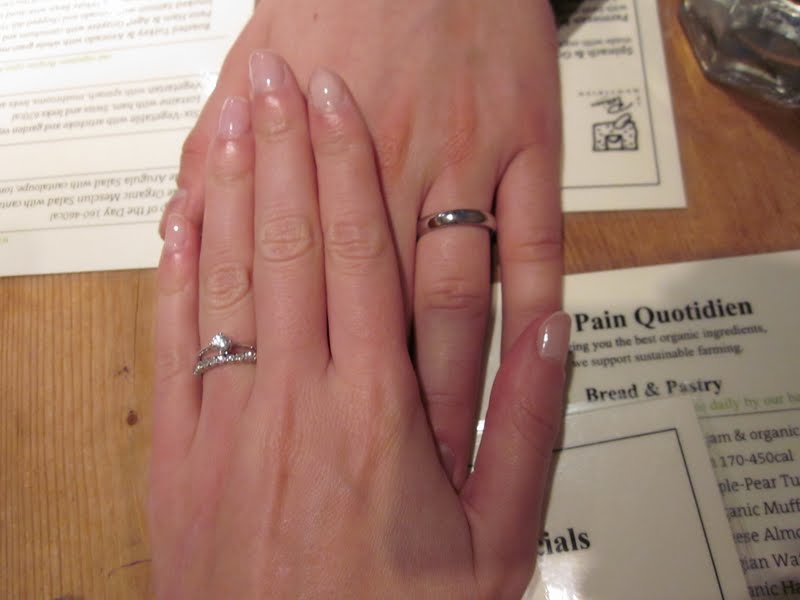
-It felt delightful waking up and realizing breakfast=cake.
-Jo's family met mine, and by all appearances everyone got along. Woohoo!
-Let's talk accessories. I wasn't up for a veil or, apparently, doing anything whatsoever with my hair beyond flat-ironing it, putting two different anti-frizz products in it, and hoping against hope that humid-and-rainy would not immediately reverse this. (Normally with such weather, I'd have not even begun such a process.) I also don't know how to much extend makeup application beyond a more careful version of my normal eyeliner-concealer-lipstick routine, other than some added blush and mascara, so there was a limit to how much primping I could fit in, to how radically different-than-usual I would look for the occasion. My mother and I did get mani-pedis on the glamorous Upper West Side, at a place I'd read online would be both sanitary and affordable, which is apparently an unusual combination, so there was some symbolic "how is this day different from all others" grooming. This was my second-ever "pedi," and it confirmed that I am in fact too ticklish for this to constitute relaxation for me. But my toes look amazing.
I at any rate had some very "Botticelli, look at you!" moments with the shoes, which were twice commented on by women after the ceremony, once on the street and once on the subway. Paris, Repetto, yes, yes, I know, I buy all my shoes like that, and if you have to ask... They were so very comfortable, but also, in that they're so very shiny and potentially scuffed, something I'll be saving for other at least moderately special occasions. The bag, meanwhile, was my "something borrowed," borrowed from my mother last-minute and a testament to her handbag expertise - it went just right with the outfit!

-And now, back to normal life. Well, as normal as life can be when they've decided to house DSK in a building next to one of our local subway stations.
Saturday, May 21, 2011
ABD now also Mrs.

It's been a busy week! More photos to come, but here's one that gets the point across.
We still need to figure out celebrations with NY friends and Belgians, as well as the apparently complicated process of turning a maiden name into a middle name, but official and unofficial-but-delicious celebrations have happened with Belgian and American family in New York. That man in the photo, he's my husband!
Wednesday, May 18, 2011
Congratulations Dr. Bovy!
-One of the convocation speakers, a professor, described the "idle" part of grad school to perfection. Replace "daytime TV" with "'House'" and "Pacman" with "fashion blogs," and... yup. But we do work hard the non-idle times, we promise.
-On the way to the ceremony, Jo's mother and I spotted none other than Abs M., less than 24 hours after the last sighting. Either a) he's a ballet dancer who works in the Lincoln Center area, or b) he's totally obsessed with us.
-And there was a physics party! I wore my galaxy shirt for the occasion.
Tuesday, May 17, 2011
"Deep physics"
This evening, I was out with Jo and his family, at the oddly-cheap-for-Tribeca Japanese place whose Grade is no longer Pending and now a respectable B. Yum! We'd just tucked into our meals, and amidst the Flemglish, I notice a familiar face not far from our table. Abs Millepied himself! I wasn't sure, so I (discreetly) asked Jo, who speculated that She might come in, which would, of course, confirm the first sighting. And who should then enter but a very pregnant woman-whom-all-men-who've-ever-found-me-even-OK-are-lusting-after.
In my last unmarried moments, I suppose I did risk being left for Natalie Portman, which I of course would have been kind of OK with, considering. This was all the more risky given that Jo had just gotten an especially good haircut at Astor Place, and considering an alleged shared interest in astrophysics (sustained, apparently* - I'd have been stuck talking French intermarriage with the Gallic beau). But a variety of factors - her being about to give birth, the presence not only of Abs and myself, but also the Belgians, created a buffer.
* Ha! "It would have been great if we had seen Jane fall for Thor, not because of what he looked like without his shirt on, but because behind the gruff exterior he knew more deep physics than she did."
Sunday, May 15, 2011
The back-ness continues
-Hamburger, hipster-made cappuccino, me-made cranberry muffins, ramps, green garlic. The food re-tour of NY is complete, or will be once scapes are in season.
Tuesday, May 10, 2011
Back, forth
-A Metrocard with a photo on it is apparently enough ID to bring to serve as a witness at a City Hall wedding. A tight ship indeed.
-Tacos, iced coffee, bagels, all lovely. Even better: access to a non-communal kitchen (and bathroom!). Made poached eggs and toast this morning without locking a door or greeting any neighbors in French.
-Also novel: having options when getting dressed in the morning. I packed very light for the semester, and am really enjoying having more possibilities than the part of the suitcase space I'd allotted to clothing allowed.
Thursday, May 05, 2011
Ding!
Dear libraries I have used or may one day use:
The book I "never returned," I did return it. Yup. I may not be the neatest of all people - clean, but not neat - but I always keep library books apart, in their own neat mini-universe, apart from the general chaos that is whichever space I'm inhabiting.
Here's what I know did happen. You know that "ding" that's supposed to happen when the scanner and barcode meet? It never happened. Either the staff member whose job it is to do this didn't at all, or, more likely, it didn't register. (I used to love scanning when my job at the library was shelving, probably because scanning wasn't shelving - variety!)
Either way, I get it, it's so obviously my fault, I obviously keep my library books under a pile of unfinished baguettes, the dorm mouse-or-is-it-a-small-rat using them to build a scale replica of the Osama McMansion. But yes, I will go look for the book, even if you're a library with a bizarre call number system and many gratuitous flights of stairs, and a rule that only those physically incapable of taking stairs can use the elevator, which would at any rate only cover some of the many flights involved. I will accept it when you express surprise that I had, in fact, returned the book a couple days before and, what, there it is! On the stacks! Or, if need be, I'll walk the miles upon miles across a certain vertigo-inducing research library because the problem was that the "ding" needs to happen with my card, not just the book, and my card being on my person, I myself have to show up even once it's been established that the book is in, thus, despite being fern,* not my fault!
*I may have called "un millefeuille" "une millefeuille," thinking "feuille" but thinking wrong, and yes, I may have seriously considered eating said item on the street around 7pm, but I'm not a barbarian! Not when it comes to library books.
Wednesday, May 04, 2011


The year in sports (got your attention!)
Since making the decision that French grad school - yes - seemed a better bet if I was going to be a self-supporting adult then did journalism, I have not given the field as much thought as I did way back when. (Still think I made the right choice! Just this morning I paid for my very own pain au chocolat that I ate at an outside table at Le Boulanger des Invalides while writing the diss...) But I've been semi-paying attention to the recent debates about why girl-journalists are so underrepresented. And I'll admit to having read Conor's list of top non-fiction essays of the past year in that light. Not knowing the gender of the writers mentioned who go by initials, I did not Google them all to get to a final count, but we're not looking at 50-50. Of the six he lists as "bloggers of the year," things are definitively not 50-50. 100-0, all six being dudes.
These are, Conor explains, his "personal picks," and I don't think we're obligated, in our personal reading, to reach demographic utopia ala elite college admissions committees. (Elderly or long-dead Jewish men are so very, very overrepresented in my own book-reading, young female grad students and academics in my blog-reading.) That the list appears not on a personal blog but in the Atlantic, with its six male bloggers to one female, does, however, change the context. It's now both a list of general-interest recommendations and one that tells readers, if you read these, you can hold your head up high.
What I noticed, in looking at the list, was that the question of whether more men than women cover Real News and the opinion field closest to it - the way this is always framed, as in, not enough women are following/confident in their opinions about the news - was kind of irrelevant. More to the point was the inclusion of sports (in the article and blog section) and the exclusion of fashion (again, not an issue if this is how an individual's reading tilts, but we're left with the impression that one is serious-person-acceptable, the other not). The "Food" category seemed like it might make up for that somewhat, but we get nothing to do with gender, women-in-kitchen-or-not, body-image, who actually does the farmers'-market shopping, etc. This is both an individual's list - subjective in a way that's interesting and a good thing - and a man's list, which is where things get more complicated.
While the list is in no way intended as a representation of what Journalism values these days, and is indeed the opinion of one journalist, I think it's fairly consistent with what is and is not viewed as important in the field. And, to reiterate, the issue is not even whether we have as many women as men out there with profound and informed thoughts on whether Pakistan knew. (I, for one, can't help you here.) It's that the fluff that gets covered under the banner of Acceptable Diversion tends to be the kind of fluff smart men follow, whereas the fluff even really, really smart women keep track of is defined as just too silly to be put in respectable publications.
Tuesday, May 03, 2011
Unnecessary find of the day:
An ad, from 1884, for a "Maison de santé pour névrotiques israélites." That's my next vacation figured out!
Monday, May 02, 2011
Further vindication: the self-flagellating edition
Part of me is thrilled to see that sanctibullying (YPISing*) is currently under attack. (See here, via/as well as here, via Scott Lemieux's twitter.) Another part of me is all, but I came up with these terms! I'm responsible for the definitive anti-YPIS writing of the blogosphere! Yet another part of me is well aware that I did not comb the internet searching for whether anyone else had ever had the same complaint before I launched mine, so I'm back to "thrilled." Full circle. Moving on...
Courtney Martin sees YPIS as a first step, a step in the right direction. She wants us to "move beyond" the calling-out of privilege, the guilt, oy, the guilt, but does not seem entirely convinced. Jill Filipovic, meanwhile, can't say enough how well-intentioned she believes the YPISers are. So close! Not quite there.
So, to rerereiterate:
-Sanctibullying is not poorly-executed social justice. It's not about wanting desperately for the world to be a more equitable place and, in one's enthusiasm for that noble cause, hitting a nerve. It's about killing two birds with one stone and claiming to be a good person as well as a self-made person in a meritocracy.
-Broader social-justice concerns can lead to increased self-knowledge, to a greater understanding of one's own privilege, and to a decreased likelihood of making clueless statements. What they can't do is tell you diddly-squat about the experiences of someone else, in particular a stranger on the internet, and how lucky they've been.
-Especially because people tend not to open up so readily about genuine suffering, or even just a not-so-well-off background. So you get to hear from the proverbial child of the Brooklyn Heights townhouse that he grew up in an outer borough and is thus hardcore, whereas the kid who grew up in East New York or even Flushing would rather talk about something else.
*For new readers (as if!), "YPIS refers to the accusation, online especially, that someone else's "privilege is showing," as in, "Why don't obese poor people just shop at Whole Foods and go to Equinox, I lost 10 pounds that way!" Except that normally, the cluelessness was less extreme, but is exaggerated by the accuser.
***********
Along the same lines...
No, it's not normal to tip at least a dollar (via) for a cup of regular coffee to go. Remember that this means $1 on a $1.75 drink. It's normal that people who make above minimum wage but not much above would want this - I certainly did when I worked that job - but it's far from expected. Claiming it is confuses people who need to understand that certain service-industry workers don't get minimum wage because of an assumption of tip income. I get that a lot of New Yorkers are ridiculously wealthy and feel a sense of guilt at the fact that they make a trillion times more than their barista. But this has all led to some kind of cultural assumption that anyone who ever goes to a bar or coffee shop, ever, is clearly enormously well-to-do, because anyone who isn't is living exclusively off home-soaked legumes. When there is, I promise, a lower-middle ground in which legumes play a prominent role, yes, but so does the occasional pre-teaching coffee. I could go on, but this has, I think, been more than enough on this topic.
USA! USA!
Perhaps never before has such a big Style news day been followed by a larger-still real-news one. Immediate-ish thoughts:
-I did tear up when I went to the NYT home page this morning and saw the firefighters watching the news ticker in Times Square. Contrary to what my Facebook friends and their Facebook friends think, the official WWPD word on the matter is yes, it's OK to cheer this death, even if as a rule, one is not a death-cheerer. And as a rule, one should not be a death-cheerer. It's not some kind of slippery slope to cheering whenever civilians or low-ranking soldiers in enemy countries (well, on the other side of the "war on terror," with its non-geographical boundaries) are killed.
-Allow me one Palin-esque moment (aside from the shared resemblance to Tina Fey, which is continuous): I think part of the wariness re: the cheering is that it's so crass, all that chanting of "USA! USA!" Meanwhile, reading the news I felt much the same sentiment, even if, for cultural reasons, I'm unlikely to drape myself in the flag and get hoisted onto someone's shoulders under any circumstances, even those that most call for it. A momentary lack of nuance in displays of patriotism is not a sign that the country has turned into one of fascist automatons.
-Or, if this seems less morbid, we can think of it as cheering the, well, accomplishment of the many people involved in the process. Seems a mission was, in fact, accomplished. And the American people united - conservatives b/c War on Terror, liberals because look which president this happened under. And if anyone's going to be a scapegoat for that purpose, how about the man responsible for 9/11?
-What will the Obama-hating wing of the right make of this? (Not sure where this comes from but it gets the point across.)
-If there is/was cheering through the streets of Paris, it's not audible from my dorm room, which suggests there isn't/wasn't any.
-Obviously this is not the End of Terrorism, of al Qaeda, etc. Why do commentators and politicians keep pointing this out as if they're arguing against something? Does anyone think this? Or, do the people who do think this matter in the conversation, in that they have clearly not been paying attention to the world around them and are unlikely to start doing so now? The more relevant question - which, to be fair, is also being asked - is, is this going to reignite the passion of his followers, making the world a more dangerous place? Is this a stupid question to ask because only time will tell?
Sunday, May 01, 2011
Vindications and more
Vindications:
-A prominent fashion blogger declares, wistfully, "Thoughts I ALWAYS think when I look through runway: '(fashion) Life must be SO DOPE when you're flat-chested.'" Another fashion writer greets the royal wedding as an end to "porno chic," which seems to amount to it being socially acceptable for women to have large breasts and not feel terrible about it. A vindication insofar as I'm always going on about how frustrating it is that a woman who wishes to look chic/understated/fashionable/whatever can't have much on top.
-Not to relaunch a debate, but this (via) is what I was trying to get at here, but far better-explained.
More:
In the spirit of Anglophilia and romance... The "Blind Date" feature in the Guardian is spectacular. At least if you're the sort of person who finds the glimpse-into-real-lives genre, in its myriad forms (letters to Dan or Prudie, alumni magazines, wedding pages, 19th C French-Jewish newspapers, Facebook-following the not necessarily fascinating lives of acquaintances, not tuning out when someone starts a cell conversation on the bus... and, sometimes, although it's insufficiently real-person, reality TV.) The gist of it seems to be that the newspaper sets up (willing!) readers at random (or is it a dating site?), and pays for them to have a meal and then answer a series of questions about how it went.
-As with the alumni mag entries Flavia highlights, the parts of these questionnaires about which topics were discussed on the date really do, in the aggregate, paint a portrait of a subset of London society that I wouldn't know how to classify, but that does seem to get at a certain sort of person. This, despite a great deal of professional, racial, and age diversity. I guess The Guardian Reader? There's a bit of a high-cultural-capital, low-economic-capital (or presenting one's self as such) thing going on - "What did you talk about? Books, PhDs, travel, having brilliant sisters, and how posh the restaurant was."
-Who/what are they rating out of 10? How smoothly the date went? How good-looking the person was? And wouldn't it be an odd start to an otherwise fine relationship if one had gone with 8, the other 9?
-The most baffling aspect of this - and is it a British thing? a Guardian-reader thing? something specific to the fact that they're reporting back to a major newspaper? - is that almost invariably, the blind-daters do not feel a "spark," yet when asked if they'd see each other again, say some variant of, "Yes, as friends." ("Sure, as people," says one. "For a laugh, sure," another.) Why, unless they're new in town and don't know anyone, would they go out of their way, in a big city, to see people they'd had so-so blind dates with? Or is it some kind of "manners" thing, where it would be rude to say "no, never," as though it implied that they'd cross to the other side of the street if they ran into the person? A romantic equivalent of female acquaintances insisting they'll get lunch soon, when neither is interested in rounding it up to friendship? Or is it, in some cases, that the person did feel a spark, but is too embarrassed to admit it in case the other didn't, and so is playing it cool while leaving open the possibility of a second date?
-Many of the "awkward" moments stem from what seem to be logistical failures the newspaper could and probably should deal with. If the paper is paying, there should not be mysteries around who picks up the bill, nor should restaurant staff be chasing the couple out for not paying. Unless, of course, the point is to see how the daters will react to this sort of challenge...
Bonjour, Bonsoir, Bonne soirée
It is rude in Paris, as it apparently is in Real America, not to say hello and goodbye in all manner of contexts that, in NY, could go either way. Entering a store, fine, fair enough, mostly true in NY as well, if not a major issue in my life as the main store I frequent in Paris is Monoprix, which is not a "bonjour" kind of environment. You can - and I do - say "bonjour" to the cashier ringing you up, but whether you get one back depends, presumably, on how annoying it was to work in Monoprix ringing people up on that particular day.
Where it's more of a complicating factor is in the dorm. Every time one crosses paths with someone else, there must be a greeting. This, I realize, sounds like a complaint from a "Seinfeld" monologue - Jerry describes having worked in an office and not known how many times/ways to say hello - as well as a "Seinfeld" episode (Leo! Helllllooo!!!). What's different in the dorm is that it's 24/7 (unlike the office) and involves perfect strangers (unlike Uncle Leo, R.I.P.). Anyone in your hall for all you know might be a neighbor, and the rule appears to be that you greet when in your own hall - other halls, it depends.
The difference between this and, for example, saying hi in a normal apartment building (another episode, the polaroids in the lobby...) is that we do not have our own kitchens or bathrooms, which means a whole lot of time coming and going from our rooms. So whether it's 9am and you're off to the kitchen or midnight and the bathroom has beckoned, bonjour, salut, bonsoir, bonne soirée.
Let's say you're cooking the following: an artichoke (they're so cheap and delicious here! not like the major-investment and inevitable-disappointment California imports at Whole Foods back home!), pasta, and pasta sauce. Using one pot only, this means several trips back and forth, to and from the kitchen. Bonbonbonbonjoursoirwhoknows. Sometimes, you just want to get the pile of awkwardly-arranged, hot, potentially messy food items back to your room - which is locked because otherwise people will, apparently, steal everything in the minutes it takes to cook something - and unlock the door, while somehow still balancing the saucepan, etc., before the timer-set hall light goes off at precisely the moment you've gotten out your key, and you're not feeling especially bon-.
Sometimes you're returning to your room from the shower in a precarious wrapped-in-towel, carrying-shampoo-and-soap situation (after refusing, at 27, to buy one of those shower caddies, and thus admit to one's self that one really does live in a dorm), and are... once again, hoping to make it into your room before the lights go out. You will say it, but you won't mean it.
Other times, the greeting culture is friendly and delightful. It depends.
The only time, as a rule, one is excused from the bon- is when one has assessed that all nearby bathrooms are out of toilet paper, and one has returned to one's room for tissues. Then, I think - and I don't know the official French regulations on this - you're allowed to pretend you didn't see the person getting the tissues or, if you're the one getting the tissues, that you were not seen doing so.
The high level of civility functions, I suppose, to mask the fact that the living conditions are... location-location-location. Short of being a servant at a palace, you're not going to find too many greater discrepancies between standard of living and standard of surroundings. Everyone's in a tiny room a paper-thin wall away from somebody else, and if not somebody else, from a construction site complete with welding, drilling, the works. Everyone's sharing far too few toilets and more tragically, far too little toilet paper. For a variety of reasons having to do with labor disputes I'm semi-following and the general tendency of college students, even nerdy ones, to be not the most tidy people ever, the kitchens are in a permanent state of garbage-heap. But! Center of Paris! Center of Paris! Proximity not only to necessary microforms, but also the Seine, the pastries, the wine, and the cheese.
Despite Paris being Paris, and none of us having exactly the right to complain, the dorm lifestyle has a way of making people, especially the pushing-30 sorts who are the substantial grad-student population, a touch on-edge. Dorm life works for those excited just to be living away from home for the first time - less so for those for whom that's no novelty. But the bonjour/bonsoir/bonne soirée gives the impression that everyone up and decided to live communally voluntarily, out of camaraderie, and not because a free room in Paris (or close, for the French undergrads) is a free room in Paris.