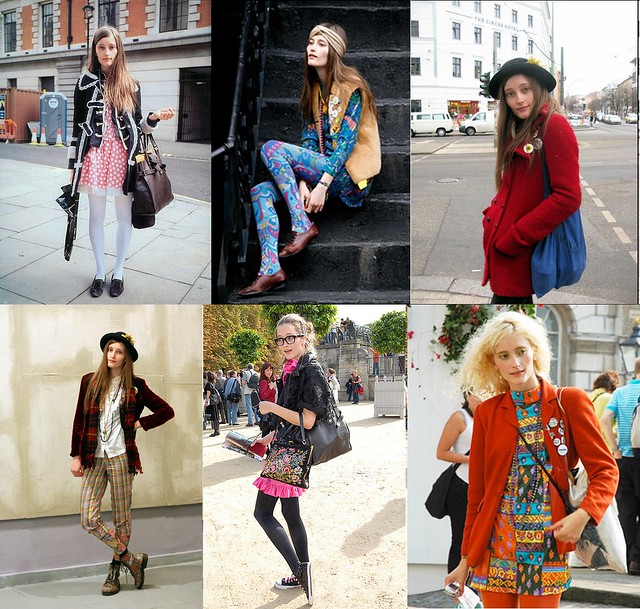
The guide below may eventually be illustrated with supporting-evidence photographs, but so far, here goes...
Where you should shop but don't:
-Kids' department, men's department: All women - except the remarkably Medium - have the option of one or the other. Or, assuming a shoe size-clothes size disparity, both. There's no need to pay up for "boy" or "boyfriend" clothes marketed at women - get the real deal for less. Plus, there's no law that says women wishing to dress like grown women in the most conventional sense need to shop in areas so labeled. Sometimes, depending on one's build and current styles, an item from a different part of the store is the one that looks right.
-Underwear as outerwear: A recent trip to the Gap told me what I already knew: there's no discernable distinction between their t-shirts and sleepshirts, sleep dresses and dresses-dresses. If anything, for basics, i.e. unadorned t-shirts you won't get sick of before they fall apart, you're better off with "underwear" tees. As for dresses, you can opt for the scandalous, or - and fine, it helps to be short - you can alternate between solid-color tank "dresses" for summer's hottest days without anyone being the wiser.
-Garden stores, uniform-supply stores, etc.: The rugged/authentic heritage-brand look is in. Which is all the more reason not to buy things of that nature at Urban Outfitters. This is less convenient than the previous two ideas, but can lead to great finds, like cheap French rainboots for Bibliothèque Nationale researchers.
Where not to buy clothes, under any circumstances:
-Concept stores: These are places like Opening Ceremony in NY, Colette and Merci in Paris, and apparently several more in these cities and beyond. They are impeccably curated and minimalistically-arranged assortments of items that cost much less elsewhere. (It was at a concept store that Clementine and I spotted the 90-euro nondescript cotton t-shirt.) If you need a refresher course on what the cool kids are wearing, by all means walk through one of these places, but consult the price tags for their amusement value only.
-Vintage stores in trendy neighborhoods: It might seem that buying used is a way to spend less and get something not everyone else has. This is true much of the time, but not if you're in a land of hipsters. By virtue of their location, the clothes at vintage stores in these areas are In. Which means they've been curated, if less aggressively than at concept stores. Which means the H&M shirt from six years ago that happens to fit with current trends will, though frayed, cost more than it did originally. That, and any place with a significant population of hipsters doesn't have the same used-is-worse stigma as do more bourgeois (or just non-hipster) neighborhoods - it doesn't occur to the staff pricing the items that customers would balk at paying that for a pre-owned t-shirt.
-Big-name luxury brands: Fine, I get it, well-crafted beautiful leather goods feel and look nicer than their Zara equivalents. But if a convincing knock-off of the bag you covet is on the arm of every woman for miles, maybe consider a different brand? Because in such cases you're paying for quality and a logo; a less-coveted make will cost less, be at least as well-constructed, and won't have people asking whether you're a fashion victim or a supporter of the counterfeit economy.
*Consider this another installment in my ongoing attempt at alienating all remaining male readers, with the apparent exception of Andrew Sullivan.
Thursday, September 30, 2010
Definitive WWPD Clothes-Shopping Guide for Women*

Wednesday, September 29, 2010
Tuesday, September 28, 2010
"For all the accusations of narcissism with which fashion gets pelted, the industry has remarkably little interest in making people look attractive."
Generally speaking, the place of models in fashion writing is far greater than need be. I don't want to hear about the village they were discovered in in Lithuania, the Italian soccer player with whom they're romantically linked, or what brand of jeans they wear in their free time.
I make an exception, however, for the NYT Model-morphosis feature. To anyone cynical, and with decent vision, it's clear that the "before" pictures are rarely if ever makeup-free. But the transformation bar is great fun, kind of like doing the makeup on one half of your face, then the next, to see what it is the makeup actually does. And maybe because full bodies don't enter into it, the fact that the images are of models isn't as distracting as it is when the topic at hand is, say, form-fitting dresses.
Meanwhile, the bulk of the commenters - straight men (or, requisite disclaimer, people who so present themselves online) - find the feature upsetting. They think the models look so much better bare-faced. What's with all the paint?
As I've said before, it's a good thing for women that men are attracted to a wider range of (wider) women than found on the runways. And it's absurd to celebrate the runway as a feminist space, where the male gaze is for once not catered to. I mean, far be it for me to complain that a touch of concealer, eyeliner, and chapstick is viewed as a more attractive look than some kind of garish art project that I wouldn't know how to achieve even with all the time in the world.
Yet there is something off-putting about the way men-who-just-don't-get-fashion march into the discussion. They seem to miss... that a runway is a stage, this makeup stage paint, not a suggestion for what your girlfriend might wear this Saturday night. That the look needs to be not only visible but also uniform - whereas day-to-day, women choose makeup to emphasize specific features, runways are all about one look for all. That the makeup is in part intended to disguise the youth of the models, to make it easier to suspend disbelief and imagine that a 16-year-old is really middle-aged - in real life a gorgeous 9th grader might not think to go in 45-year-old-woman drag. That makeup isn't permanent - a surprising number of the commenters (and some of these may be female commenters) pity the models, not because they need to weigh four pounds, or live in cramped apartments far from their families and their junior high schools, but because someone has put unflattering makeup on them, as though soap had not been invented. That the goal of runway paint isn't prettiness - people who I suspect would never dare enter art museums and ask why not everything there was a painting of a kitten nevertheless confidently announce that the goal of a fashion show is to present women at their easy-on-the-eyes.
But mostly, they miss that the way runway models are made up at a fashion show isn't about pleasing straight men. Fashion isn't about pleasing straight men. I mean, they realize this, but they see it as a strike against the fashion industry. Because this is how the commenters present it - that their preference for (what they perceive to be) bare-faced is evidence that the fashion industry is one big hoax. Women are being suckered into buying makeup and clothes that don't even make them more appealing to men!
Where to go from here? One might start with Hadley Freeman's brilliant take on the matter: "Is fashion a cruel anti-female industry whose sole goal is to make women feel bad about themselves and force them to wear crippling, uncomfortable apparel? Or is it empowering, allowing women to wear clothes that appeal primarily to themselves as opposed to men?" And, and! "For all the accusations of narcissism with which fashion gets pelted, the industry has remarkably little interest in making people look attractive. It's interested in making people look different." Yes, this.
Still, I think the relationship between What Men Want and Fashion is a bit more complicated than all that. In a sense, if it were up to straight men, there'd be no Fashion, just a timeless get-up pairing cleavage, long hair, miniskirts, and heels. In another, however, one that acknowledges straight men as complex human beings, there's the fact that looking of-the-moment (or of a particular subculture) is something humans value in other humans, across the gender and sexuality spectrum. A 1988 version of Sexy Women's Outfit would look off even to self-professed fashion-ignorant men of today. All of this is to say, even in dressing without pleasing men as a goal, women may end up doing so unintentionally, because looking current is a way of appealing to others generally.
Monday, September 27, 2010
If it ain't broke
Just... just... how?
How is a "broke" recent college grad prepared to go on $50-a-person dinner dates? Doubly bizarre if the Young Person in question intends to pay for self and date alike.
How could the NYT food critic - someone charged with knowing more than the average person about dining out in NYC - say that no "date" restaurant in this price range exists?* I get that not everyone considers Thai food off a tray in Chelsea Market hot-date material (the food is hot...), but the sub-$50-a-person options are endless. (That, or I'm naive about restaurant alcohol consumption of non-grad-students, and this $50 is meant to include pre- and post-dinner drinks, along with at least one bottle of wine with the meal.) A good place to start would be Celeste uptown and Bianca downtown - basically the same Italian restaurant, where unless your date orders three different pasta entrees (not a bad idea if you order the ravioli with sage and butter sauce - delicious but the portion's tiny!), you're in the clear.
*Preempting the obvious: Sifton may have been trying to make a cutesy remark about how sometimes drinks are a better idea than dinner for a date, not to say that literally no such restaurant exists. But the remark - "With the budget you are presenting" - suggests he really does think it's not worth the bother of eating in a restaurant where the total bill for two is under $100. Which is something between aloof and absurd.
Sunday, September 26, 2010
WWPD Investigations: Fashion and Beauty, Part I: why artifice?
It is generally assumed that hair-and-makeup artifice is intended to improve in specific ways - either to fix or to enhance. The implication: fix and enhance for men. Lipstick and blush, goes the thinking, give the illusion of sexual arousal, while brunettes going blonde, or women with gray hair covering that up with any other "natural" shade, are trying to look more youthful. It is accepted that women - or the fashion-victims among us - experiment with dress, but Beauty is oh so sacred. Sure, there are punks and goths and whatnot, but past 10th grade, women, goes the theory, want to look Nice.
Friday, September 24, 2010
In praise of orange-red
Wantwantwantwantwant. This one in particular. Meanwhile, I am a sensible grad student, and will content myself with the recent purchase of two Essie nail polish shades for $9 (as in, $4.50 each) at a street fair. The "Clambake" one is, I have to say, most excellent, the nail equivalent to Nars Heat Wave lipstick. If you're always finding that "red" cosmetics come out too pink, orange-tinged is the way to go.
This is, by the way, as much cosmetics-blogging as I can muster. I wish I knew how to wear makeup, and take no pride in the percentage of my days I go the "natural" route, but anything beyond nail polish, lipstick, eyeliner, and concealer is beyond my capabilities, and it's a rare day I make even that whole checklist. I can see how various additions - eyebrow pencil, blush, eyeshadow - would improve my appearance if applied correctly, with a steady hand, but my attempts have led to this, this, and a messier version of this, respectively.
Wednesday, September 22, 2010
Sincerest form of flattery

Tuesday, September 21, 2010
"'Vanity is a great motivator,' he said, between sips of jasmine green tea with cinnamon [...]"
27 really is that age. It's a number that always sounded adult to me growing up - possibly because that's the age my mother was when she married my father, possibly because it's not an age at which I ever imagined I'd still be in school. ('All-but-dissertation' is still 'school.') Quirks of the New Yorker aside, anything you accomplish at 27 is the achievement not of a precocious genius but of a full-fledged member of one's chosen field. It's an age at which no one's calling Lifetime on you if you choose to become a parent. (This example brought to you by the fact that, despite the window being closed, I can hear a deep-voiced man yelling "WHEEEE" at the top of his lungs in the playground downstairs. I can only hope a child and a swing are involved.)
27 is also, it seems, two years too late to start worrying about wrinkles. "Seems" because this is a NYT Styles invent-a-trend piece. There is, alas, one of those "Enlarge This Image" features on the accompanying photo of a 27-year-old "dating blogger from Brooklyn." "Alas" not because there's anything wrong with the way she looks, but because, given the topic at hand, the option to "enlarge" all but forces the curious reader to check out her skin elasticity. And she looks... 27. A tragedy, I know. How do we 27-year-old women even get out of bed in the morning?
This 27-year-old woman gets out of bed because of such a thing as Oren's Daily Roast Viennese Blend, a miraculous anti-aging product if I've ever encountered one. Also sunscreen. In that entire article about preemptive war against wrinkles, not a word about sunscreen? Sure, even the non-acne-causing ones cause breakouts even in the not-acne-prone (and old - have I mentioned old?), but a) the occasional zit gives us a youthful air, and b) I'll take Neutrogena SPF 85 over "Supermodel Legs, a cream with chili pepper, [...] meant to be applied whenever 'you need runway-ready legs,' according to the box." Meanwhile, if you're over 25, you can rest assured you don't need runway-ready anything.
In a nutshell: the problem with Jezebel
Do I read it and enjoy it? Sure. But a certain aspect of the site could use some tweaking. Without dipping into their archives, from what is, as I type, on the site's front page. We have...
-A post about oh noes Photoshop. Click on the post to find images of models in bikinis and their measurements. But the Kate-Moss-in-her-underpants is justified because it's to make a broader point about The Media and so forth. (Sorry you had to see that, Battery Park City library-goers.)
-A gallery of pretty photos of pretty runway models prettily walking down the runway. No critical commentary about their weight, height, or youth. Just a celebration of that-which-is-easy-on-the-eyes.
-An indignant entry into the ongoing saga of Gabourey Sidibe's Elle cover. Was her skin lightened, or was it just that that's what flashes do? Should the stylists be accused of racism on account of how her hair turned out (not good seems to be the consensus, but I'm not seeing the problem), or are the real racists those who think her hair is a mess? The same-old same-old discussion ensues, in which anyone who does not declare this actress the very epitome of female physical perfection (even though she gained fame in a role she won in part because she doesn't fit conventional ideals) is insufficiently sensitive to large or dark-skinned women. What what? Might there be something patronizing about the "Gabby is gorgeous" chorus? Not a chance.
-Oh, and at a movie premiere, "Carey Mulligan looked absolutely adorable." Aw.
Monday, September 20, 2010
On being back home for a bit
-Never having had the option of Walmart, I never looked into its viability as a place to buy groceries, but if one were to open in lower Manhattan, yeah, I'd check it out. I've kind of had it with Whole Foods being the "cheap" nearby supermarket. (Gristedes, I'm looking at you...)
-Speaking of groceries, I schlepped rather a lot of Amora mustard back from France. It's under a euro at supermarkets in Paris, but simply impossible to find in NY. Or not - it's apparently $3.99 for a large container at Zabar's. Not as good of a deal, but the Zabar's one doesn't involve having one's luggage scanned a second time upon arrival at Newark.
-Every woman in NY of a certain socioeconomic status is now wearing army-green skinny cargo pants. I googled the phenomenon, and it was apparently one of spring's big trends. If I'd missed this, it's because these were most certainly not what the women of any socioeconomic status were wearing in Paris, where cargo pockets always have and always will scream American. Now back in NY, I noticed a pair of said pants at the semi-permanent sample sale in Chelsea Market, where they were going for $140. This was the reduced price. While I suppose the same could be said of all trends, this one, more than most, strikes me as an item which owes its entire appeal to the fact that women are seeing it on other women richer and better-looking than themselves. Nearly every time I see a woman in these pants, she's paired them with of-the-moment-yet-subdued accessories and a gym-honed physique. This gives the impression that the pants are themselves flattering, which is doubtful.
-The one rich lady not wearing skinny cargo pants is Real Housewife Kelly Bensimon. I saw her, in tiny shorts, jogging through traffic - this is, as my fellow intellectuals know, her trademark - with a tiny Maltese. It seemed unfair to the dog, both to make it run in traffic and to make it run alongside a fit six-foot-tall human at all. Kelly, if you're reading, at least let the dog take the curb!
Sunday, September 19, 2010
"Welcome to a taste of Paris"
Need a new system for getting photos here, but this show poodle at a Columbus Ave. street fair was the highlight of my day. I'm considering devoting this blog exclusively to action shots of lap dogs.
Friday, September 17, 2010
"You cut your own bangs and you think they look good. (They don't.)"
-Gawker has a "Signs That You're Poor," city edition, guide, and, um. I don't think of myself as poor, just as doing quite well considering I'm a grad student, but this sure hit home. While I meet several more of the criteria, "You know when things go on sale at the thrift store" and "You cut your own bangs and you think they look good. (They don't.)" are the two from which I most ducked in horror. Housing Works has another $5 special on jeans! Yes, I know this! And nothing short of one of those $800 haircuts could fix what I've done to my bangs, so I'm letting them grow out. A commenter also offers, "You know at least four recipes whose core ingredients include a small can of tomato sauce and a quarter of an onion." But aren't the large cans more economical? Anyway, I think this list confuses poverty with frugality. Just because you could pay someone to cut your hair, or break the $30 barrier buying pants, doesn't mean you need to.
-It would be great if once, just once, an American food writer could be inspired by something other than time spent as an expat or tourist in Frahnce. Will that day ever come? No. Even the NYT "Recipes for Health" blogger - advocate of a béchamel made with low-fat milk - is guilty:
When I lived in France I began to travel a lot to Provence and to the Mediterranean, and that’s where I began to learn a lot about those cuisines. Living there really shaped my cooking in many ways. There is another thing that really affected me and is a running theme in my writing now: the French stop for meals. They don’t eat between meals because they’re not hungry. That’s so different than the way Americans eat, and I think there is something really key there.Meanwhile, what I'm appreciating most about 'merica is the snacks. Well, the iced coffee and the snacks. Sure, snacks are better in France, but you have to eat them, shamefully, while walking down the street. If you want to eat between meals, say while reading for your dissertation, at least this is possible in NY. The other day I got a slice of lemon poundcake and an iced tea at the bookstore café on Prince near Mulberry and seriously just reveled in the fact that such a place exists.
-I'm confused. I know Jezebel is the blogosphere's home for misplaced pseudo-feminist outrage (commenters who mention specifics re: weight, calories, or dress size are admonished that "numbers can be triggering" to those with eating disorders... yet many posts include photographs of runway models, it-girl actresses, etc.... but it's all OK because the blog is leading the campaign against womankind's principle enemy: photoshopping). But this post I really don't understand. An American singer of half-Mexican, half-Scottish origin used to dress up as Frida Kahlo and now does not. She has sold out to the ideals of whiteness, it seems, by getting a tattoo and, more bafflingly, a tan. Meanwhile, "Colonial" standards of beauty are especially oppressive to the blogger, on account of her "Iberian" complexion. Weren't the Iberians the colonizers? I am predisposed to understanding without explanation oppressive-beauty-standard complaints from those with thick, dark, frizzy hair and pale skin, but this? I'm just not following.
The WWPD Guide: Trend Anticipation
This is the new look, and it's time to get used to it.
This is, by the way, a shot of the same woman (same day, presumably) as the Sartorialist photographed to illustrate the difference between fashion and style - the photo was meant to exemplify the latter. An outfit the Sartorialist perceived as a rejection of the trend cycle I (along with, apparently, Refinery29) read somewhat differently. What I find compelling about the get-up - aside from that I'm delighted that wide-leg jeans and floppy hats are so-very-now - is how it illustrates the principals of trend anticipation: the look is current because of its one-by-one rejection of that-which-has-been-so-very-now-for-just-a-bit-too-long.
Examples: Dark, skinny jeans have been every woman's default? Trade 'em in for pale-blue flares. Wayfarers have become synonymous with sunglasses? Go for giant round frames. Fedoras and porkpie hats have been the it accessory since Agyness Deyn and the rest of Williamsburg declared them so? The time for wide-rimmed has arrived. It-bags with studded black leather give way to a brown clutch. As for the blouse, nothing remotely silky-'70s has been fashionable since I can remember, which is to say since the mid-'90s. This woman is so unfashionable that she is, in fact, ultra-fashionable. Thus the Refinery29 post on how to use the outfit as inspiration for how to rock the current trends. Thus the overlap between the outfit in question and what are, as of five minutes ago, the current trends.
In other words, by picking the opposite of a bunch of fashionable styles, this woman has created a look that gives the impression of having staying power, which is what the Sartorialist picks up on. And it probably will look "now" for quite some time. Trend anticipation is not frugal in the same way as, say, not giving a crap and only wearing Old Navy basics bought around the time that chain first appeared. But skinny jeans or leggings-as-pants were a better "investment" (or, more accurately, a better buy) five years ago than they are this afternoon.
This is the moment, I think, for me to clarify what I meant in terms of fashion, in fashion, things looking dated, and so forth. I'm not talking about that which only fashion-types notice, both because that's not the point and because (even though, fair enough, I read some fashion blogs, and neither Paris nor NYC is representative of how much The Average Person cares about clothes... with some exceptions) I wouldn't be qualified to do so. I'm not talking about trendiness, aka fads, aka the things in H&M all but the most daring/fashion-victimy of us pass by on our way to low-priced basics. I'm referring to the changes in silhouette, both of individual items (boots, pumps, pants, jackets, etc.) and of whole outfits, that can mark a wearer as looking of a different era, or of the one in which she lives.
Most of us - not all, dear contrarian commenters, but most, and with the caveat that it's entirely possible that 99% of men, yes including gay men, don't much care about clothes and I'm conflating "humanity" with "women," "women" with "women in NY," "women in NY" with "yours truly" - do want to look at least vaguely current. Attractive, individual, appropriate, or subculture-specific as well, perhaps, but also of-this-age. Thus the "timeless" marketing idea in the first place - if it wasn't a problem, in the eyes of many consumers, to look dated, there'd be no need to shop for "classics." We could all just buy well-constructed jeggings and wear those for years. But once we admit to ourselves that we'd rather look "now" than "five years ago," the best way to approach buying new clothes - or choosing which old ones to bring back into the mix - is to embrace the opposite of all current silhouettes. Predicting specific trends, aka fads (horizontal-stripe shirts, knock-offs of Chanel's newest nail polish colors, hipster-Victorian-artisan) is futile, but also irrelevant to this post. Meanwhile, getting the overall outline right is very doable. It is, at any rate, something I did unconsciously for years, until trying to figure out why, despite not being particularly well-dressed/stylish/fashionable/glamorous/you-get-the-idea, I often find myself ahead of trends.
Thursday, September 16, 2010
"Made in Italy by Chinese"
Recently, I noticed that some of my t-shirts have "Made-in" labels that go above and beyond the usual information. These garments were, it seems, Designed in France, then Made in Morocco. It doesn't require a grad seminar on Edward Said to figure out why this might be spelled out. What the label is doing is saying, yes, you'd imagine these shirts to be French (ahem, Petit Bateau), but in all honesty, they were assembled elsewhere. But! Fear not! French workers were involved! Not only were they involved, but they participated at the highest level! When I noticed the label, I imagined a creative-professionals office, something like an architecture firm, where only the most Gallo-Celtic assemble to decide just how far apart stripes must be placed to be authentically Breton.
Clothing brands often send the same message, if less explicitly. H&M evokes Sweden, but this is not (sorry to disappoint) where the clothes are produced. Uniqlo is all about Japan, but very much Made in China. Then there are the Americana brands - if you're under the illusion that GAP, Levis or J.Crew are hand-crafted by rustic Real Americans or recent-college-grad Brooklynites channelling that spirit in a warehouse somewhere, you're in for a shock. There's the country whose aura you're purchasing, which is rarely the same as the the one the clothes are actually from.
But what if the countries of image and origin are one and the same? Problem solved (assuming one sees the image-origin mismatch as a problem), one might think. But no! What if there are ferners involved? And what if what's at stake isn't skankorifically-advertised American leggings, but Quality European Goods?
The perils of Italian production coming from those without Italian blood in their veins has shifted from food to textiles. The comments to the Times story are, I think even to someone less enthralled by newspaper comments than I am (and I'm so enthralled that my dissertation is about, in part, the 19th C equivalent - angry letters to parochial newspapers), kind of amazing.
Three different commenters are excited to learn that this is why their shoes fell apart so quickly. The Chinese! Another has this charming suggestion: "They should label the garments "'Made in Italy by Chinese,'" a sentiment shared by others as well (A moment, please, while I label this blog post, "Made in the U.S.A. by a Jew.") A recommended comment compares Chinese and Japanese workers to ants, and deems them incapable of producing quality goods.
However, the comment that struck me most was this one:
I remember so lovingly the beauty and quality of "Made in Italy" when I studied in Florence in the late 60'sand 70's: the fine materials, the extraordinary workmanship, the pride with which shopkeepers showed off their wares.When one returns to Florence today it is a very different city and almost heartachingly painful: the leather shops, the embroidery, the housewares are all sold by shopkeepers who don't even speak Italian, much less understand, or appreciate, what they have displaced.What a shame that some of the city's greatest traditional handiwork, not to mention their elegant taste, is fast disappearing and going the way of cheap globalization.Where to begin? Do the shopkeepers "not speak Italian" as in, one is unable to make a purchase from them in Italian, or is it that they're chatting amongst themselves in a language other than the one the guidebook promised, until you enter and ask to be helped? Is this an issue of communication or aural aesthetics? Must a kerchiefed matriarch stirring the local cuisine emerge from the back of the workshop at mealtimes?
Next, if you're visiting a place as a tourist, even a tourist who went on study abroad in the place way back when and so might have a particular interest in the region, how on earth do you know if store clerks "understand, or appreciate, what they have displaced"? Is this something people even wonder in their own hometowns?
Finally, when are concerns about craftsmanship, quality materials, and labor conditions just a proxy for racism? If there's racism, it's of a particular sort - the quest for authenticity is about consistency, not whiteness. The idea being, Italian stuff had best be made by Italians, not Chinese immigrants or Swedish ones. And the let-down at Uniqlo, in this line of thought, wouldn't be that East Asians made the stuff, but that it's made in China rather than Japan. Regardless, I suppose part of what I'm missing here is that I find it tough to wrap my head around the mindset that would find it "almost heartachingly painful" that clothes and accessories aren't made like they used to be.
Tuesday, September 14, 2010
What Would Ms. Babcock Wear?
"Should Be On The Nanny" is officially the most brilliant fashion blog - no, blog, period - ever.
And alas, my brief fascination with the camel-beige color scheme (inspired by a different sitcom character) may have been cut short. Thanks a bunch, CC.
Brows high and low
First, shortly after waking up, I killed an especially agressive mosquito. Then I defended my prospectus. Somehow I figured the luck with the mosquito was a good omen for being ABD by the afternoon, and I was correct. If only I hadn't just put hair goop on my hands when the moment came to reach for the New Yorker and slam it against the mirror where the plump insect rested in the moments between attacks, then the process would have gone forward smoothly. As it stands, I've got smooth hair, a magazine unlikely to frizz even in high humidity, and a dissertation to complete.
Tangentially related: I need to expand on the portion of my thesis that deals with the belle Juive. As good a place as any to start is this Daily Mail "article" which juxtaposes photos of Rachel Weisz, Natalie Portman, and Winona Ryder. I have no idea if Weisz is even Jewish, but she is exactly the woman I picture whenever I find references to belles Juives. Portman, though plenty belle, is not, because the belle Juive always has strong features and raven hair. Regardless, I appreciate the British tabloid assembling these images of vaguely Semitic beauties, because (and I realize this is ultra-tangential - we've left the ivory tower and headed down Broadway to Sephora) I recently purchased my first eyeshadow since middle school (this time going for a silver-gray-black palette, rather than sparkly blue), and I'm trying to figure out what to do with it. Images of the professionally-made-up faces of women with my coloring and idealized versions of my own features are all kinds of useful.
Class and snobbery
Prudie's response to letter-writer #1 would make perfect sense - perfect! - had the letter-writer said that, on account of his possible future inlaws being Catholic and lower-middle-class, he figured they'd be rabid anti-Semites. In that case, yes, he's being a snob. Or if not a snob, just incredibly sheltered. If the guy has never left a liberal-well-educated-culturally-Jewish sphere, his assumption that upon leaving the bubble, he'll encounter pogroms would be, if not reasonable, attributable more to ignorance than snobbery.
But! He is telling Prudie that they, as in, this particular family, have "a penchant for saying alarmingly inappropriate things about Jews and other minorities in my presence." He's not judging families like this one, but a specific set of real-life people. This is not prejudgment. It's judgment, plain and simple.
Why, then, does he bring up the difference in class? My guess would be that the man was raised in the age of "your privilege is showing" and wants to make it clear that he respects, from a distance if not in his own family, the right to say things that it is their own cultural tradition to express. Now, one might argue his ignorance is showing - one hears at least as much anti-Jewish venting from well-educated types. Or that he's being patronizing. But if he's mentioning class at all, it's to explain why he puts up with their comments in the first place.
Meanwhile, there's a glaringly obvious answer Prudie missed: the guy is jumping the gun. He doesn't mention how long or how seriously he's been dating the child-of-a-bigoted-home, nor how old either of them are. Something about the importance he places on their families' attitudes, his choice of "beautiful" as the trait he's most drawn to in his girlfriend, and the fact that he doesn't seem to have dated much, makes me think they're both very young. It doesn't seem from the letter that this is a couple about to get married. I'm picturing a boy of about 19, projecting and overanalyzing and otherwise using a college relationship (because college is where Young People of Different Backgrounds Meet For the First Time) to think through all the possibilities his life might have in store for him. If a young woman had written the letter, Prudie might have pointed out that she was thinking too far ahead, as women are wont to do. But young men are also guilty of this behavior.
Sunday, September 12, 2010
"Timeless classics"
So I'm of the opinion that the "timeless classic" - that clothing item or accessory that will never look dated - is a myth. A myth embraced by brands and consumers alike, because everyone wants to work under the impression that purchases will be worn for years. Stores want customers to think they're getting a good deal and being sensible, and that this justifies spending an extra thousand dollars on a certain brand of raincoat or whatever, while shoppers pride themselves on good taste and eschewing frivolity.
How timeless is timeless? Are we to believe that Louis XIV's Levis and Converse would totally work today? It would make sense that a "classic" would be a look meant to stay in style for the duration of a normal human lifespan, or the years of it spent at more or less the same size. But then there are those watch ads, with the father who'll pass down the watch to his insufferable looking son, styled to resemble Brighton from "The Nanny." For every item costing over, oh, $1,000, there needs to be at least the notion that it will stay in one's Fine Family (as opposed to the Fine family) for years.
There are several reasons I doubt "timeless" is a real phenomenon, beyond the marketing. For one, even if you restrict your sample population to one subculture, how that subculture dressed in 1979, 1988, and today will not offer much in the way of direct overlap. Take a subculture known for timelessness: preppies. The general idea and color scheme remains the same, but the specific brands and styles come and go. (Remember Hervé Chapelier? Once ubiquitous, now at the bottom of every closet on the Upper East Side.)
Next, there's the fact that brands and styles known as "classics" aren't so much timeless as prone to cycle in and out periodically. Keds, Doc Martens, motorcycle jackets, these will probably never leave us altogether, but they go through decades of being 'that thing I wore way back when' before returning to social acceptability.
Finally, there are the many, many, many subtle changes - i.e. "fashion" - that make clothing either look "then" or "now," but that are not always predicable at the time. The obvious example is pant-leg flare vs. taper - a bit of fabric makes the difference between looking like you've made an effort and looking like you last bought pants in high school. (Which, given that it implies a constant dress-size since high school, might be something some would want to cultivate?) There is not a single pair of jeans in this universe that will always look current. The cut of skirts presents the same issues - pleats, waist height, and overall shape, not even bringing in the issue of hemline. I mean, I can look at t-shirts I bought a few years ago and detect their few-years-ago-ness, even if they're still in decent shape. It doesn't stop me wearing those t-shirts, but the point isn't whether one can continue to wear clothing for years (one can, and the one that's typing this sure does), but whether one's closet, if properly stocked, can make one avoid looking dated.
A commenter, however, claims that "timeless" exists. I'm willing to accept the possibility, but only if specific timeless items, or better yet full outfits, are identified. So, readers, if you have any ideas, comment away.
Saturday, September 11, 2010
Friday, September 10, 2010
Last word on ma'am
I went running today for the first time since I suppose June, and had the good fortune to notice an NPR interview with Natalie Angier about "ma'am" in my iTunes. Angier made some useful points that I wish I'd made at Amber's. Basically, the way Angier frames it, the issue is that ma'am is in theory about making social interaction more pleasant. If it no longer does so, and in fact irritates many recipients, then it's a problem. Contrarian blog-commenters will point out that they use/don't mind receiving ma'am. Fine. Enough women do, and (other than a MTF transgendered emailer to NPR, who did make a good gotcha point) exceedingly few women seem to have positive associations with receiving the term. And, Angier points out that the alternative to ma'am doesn't have to be a neologism, or calling even the elderly "miss," but that it's entirely possible to do away with honorifics in day-to-day life altogether. Politeness can be achieved in most situations with "please," "thank you," and "excuse me" alone. She also mentions that it's all but impossible to make one's dislike of being called "ma'am" known in a day-to-day situation without making a fool of one's self.
Finally, even though she spells out that she understands there are cultural variations, but that ma'am-as-way-of-making-women-of-a-certain-age-feel-awkward, aka ma'am-vs.-miss, has a life of its own outside the South and outside military life, the podcast was full of responses from Southerners and members of military families insisting that they were raised to ma'am. Things got a bit circular, but given that my activity while listening was running one direction only to run back the other way, it seemed about right.
Consider the dead horse beaten.
Thursday, September 09, 2010
And populist rage ensued
Living in Battery Park City and not working in finance makes one particularly aware of the fact that one does not work in finance. So I've long since gotten used to stocking up on pasta at the same Whole Foods where bankers shop for a presumably more varied set of wares (or, I suppose, to-go boxes, what with the hardcoreness of their work), and of dragging the tote bags back home past a whir of blue button-down shirts enjoying a seemingly eternal hour of happiness outside the Financial Center. But it's overall worth it - affordable, same-as-outer-borough rent (if you get a good deal and share a studio); the waterfront; and, when not closed by whim or Board of Health or whatever, a short-ish walk to Tribeca's Bouley, home of the city's best pain au chocolat. What I wasn't prepared for was the following: in a running shop, I overheard a guy at the register being informed that, on account of he works at "Goldman," he gets a 10% discount.
Tuesday, September 07, 2010
Another '90s-themed celebrity sighting
After running approximately 300 errands, I found a bench near campus and just kind of parked. I looked up and saw a very thin woman, in spike heels, with plump(ed) lips, and with hair that I remembered from way back when and that set her apart from all the other otherwise similar-looking women of the area. She was holding forth into a cellphone, but it was when I heard her mention Seattle that I knew for sure. Courtney Love! I watched her pace and talk, waiting for a cab. And then, in a moment that was, I promise, more surreal than it sounds, I had to move aside my shopping bags from Duane Reade and Ricky's (where my favorite conditioner was on sale) because Courtney Love was coming to sit down right next to me on the bench. I was reading over a draft of my prospectus, but Courtney Love's aura made it somewhat difficult to concentrate. I'm down to trying to fix the first paragraph. Part of me was tempted to ask her what she thought of the first sentence - then I'd be able to thank Courtney Love in my dissertation! - but decided she probably had better things to do than help me present my research with that special grungy edge.
Monday, September 06, 2010
My lady
Natalie Angier correctly defines what makes one "ma'am" rather than "miss" in our society as whether or not one was born before the Clinton years. Given my delight at getting an iced coffee at the same place Chelsea Clinton gets hers (where no doubt we were both called 'ma'am'), I find Angier's definition entirely convincing. (Katha Pollitt's suggestion of a switch to "Madame" ignores, alas, that where there are Madames, there are also Mademoiselles.)
One problem with ma'am that neither Angier nor the letter-writers mentions is how the age cut-off itself is an issue, particularly in the context of the trappings of adulthood beginning later and later. When a 22-year-old gets ma-am'd, she's reminded of the grown-up existence someone her age ought to be leading. Home ownership? Husband? Finished with schooling? Any babies on the way? The miss-to-ma'am switch has not caught up with the Age of Transition. It's not that 20-somethings are under any illusions that we look 14. It's that "ma'am" reminds us how little our lives have changed since then.
Conversely, for the 20-something who isn't meandering and finding-herself towards adulthood, ma'am is a reminder of how staid and square one appears. This is particularly true of ma'amming that takes place at hipster coffee shops, which I've found to be prime ma'amming territory. The baristas, male or female, will ma'am female customers their own age, as a reminder of what life in a cubicle does to one's skin elasticity.
The pro-ma'am counterarguments don't strike me as all that convincing. Yes, it's regional, but is every single person working in NY from the South? If 'ma'am' were a quirk that went along with a different region's accent, we could all chalk it up to diversity, and those who resent being called ma'am could be chastised for anti-Southerner discrimination and sentenced to 20 straight hours of "Designing Women." But it's clearly, clearly, a term used in the Northeast, by those native to the region, with its own set of connotations here.
The argument that ma'am is a term of respect, and that women should be proud rather than ashamed of having reached a certain age, also falls flat. It's not that we're self-hating old people. It's that our non-nubility isn't something we feel needs to be acknowledged in a greeting, especially, as Angier points out, when men who are no longer fit 19-year-olds don't get a special term of address. I could think of any number of descriptive terms that would bring up other visible-at-first-glance qualities I'm not ashamed of but don't need announced: 'here, short person with very pale skin and very thick if frizz-prone hair, here's your iced coffee.'
Sunday, September 05, 2010
On the other end of the Hermès spectrum
Jo and I had dinner with my family on Bleecker Street, which considering we live in Battery Park City ought to have meant a reasonable trip home. But! The train we were on stopped running at Canal, while our other option was running express and thus not stopping at Canal. This left one possibility subway-wise, which was to pay once again to take the uptown train and switch at Union Square for a downtown express. Was any of this announced? Were there signs? Not so much. So we got out at Canal, figuring that this was not unwalkable.
Wrong we were. Canal Street, at night, these days, is apparently a giant open-air market for knock-off handbags. I'm not talking about the standby vendors on every other street corner around Mercer and Greene who, during the day, sell Real-American tourists fake Louis Vuitton from garbage bags until the cops shoo them away. (Foreign tourists, who face larger penalties for bringing this kind of nonsense home, seem not to go for this.) Nor am I talking about the stalls that line Canal and that semi-permanently sell this kind of thing. I'm referring to a full-on, can't-walk-through-it mob of vendors and eager shoppers absolutely filling that block to capacity. I've been on Canal Street countless times over the years, at all hours, and had never seen anything of the kind.
We eventually pushed our way through the determined horde, but not before a vendor told Jo that if we weren't there to buy bags we had no right being on that block in the first place. And, um, if the train stops at Canal and you live south of Tribeca and you need to get home? You're supposed to summon an interest in designer knock-offs, show your trademark black garbage bag as a sort of ID, and then and only then are you allowed to go to your apartment?
While disapproving of their behavior, I can summon a kind of sympathy for the men selling the bags, who presumably didn't choose this over consulting jobs at McKinsey. The logo-crazed women clogging the street, who could just as well buy cheaper-than-Louis-Vuitton non-knock-off handbags like everyone else, not so much. What is with these handbags? Is the point to convince the folks back home (or your neighbors elsewhere in the city - maybe some of these women live in NY?) that you're rich? That you're clever and got a 'deal' because your bag has "LV" on it and you didn't pay what that normally costs? Can't these women wait and go to Century 21 in the morning, which is at least indoors?
I would classify 'I had a tough time getting home on account of messed-up train service and rampant, vaguely menacing, illicit commerce' as a First World Problem, on account of this happened in lower Manhattan and didn't end in BBC-report-worthy tragedy, but somehow I don't think it's quite FWP either. Maybe First-and-a-Half?
Effortless beauty, continued
A Parisienne describes her own look as "effortless." What does this effortlessness entail?
-"This is my way of being bourgeois: a camel coat from Phillip Lim. Everyone has to have a camel coat this season."
-"I have a lot of handbags, but no Hermès. So all my friends have to do something about that for my birthday — it's the fifth of November. I also like diamonds."
-"I love fashion, but I'm not a shopping addict. I'm never like, 'I need these shoes by Miu Miu!' I don't kill anyone for this. I prefer well-made basics that you can keep: the right trench coat, a good leopard-print coat."
To someone who doesn't read much about fashion, the distinction between stocking a closet (or several) with silk Balmain blouses and leopard-print coats, on the one hand, and designer shoes, on the other, might not make sense. So, to translate, what she's getting at is, she's low-maintenance. She prefers basics and classics to trends. Sure, she's pretty much constantly acquiring big-label clothes and accessories, but her concern is durability - she'll wear these things for years.
To be fair, what she's describing as effortless is her "no makeup, natural hair" self-presentation. The accompanying photo is too small to assess if there's makeup going on (and even someone who didn't wear makeup generally couldn't be faulted for wearing some when being photographed), but if her hair is "natural" that's in texture only.
The thing is, I don't fault her for any of this - the YSL blouses, the somewhat predictable taste in accessories (diamonds and Hermès, really?), the elegantly bleached hair (if I had a guarantee it would turn out like that, I'd seriously consider going ombré-roots blonde). And I'm very much in favor of a camel something for this season, but probably a sweater. I am also a "madame" these days, with far too many t-shirts. I get that.
What bothers me is the way dress has to be discussed, as though a straightforward, 'I'm known for how I dress, and here's how I determine what does and doesn't make the cut' isn't enough. A disclaimer along the lines of, 'I don't really care how I look, or whether what I wear is in style,' has to be woven into even an interview where it's abundantly clear that the interviewee cares deeply about both. Again, my issue is not with her caring, it's with the charade of her not caring, a charade not particular to this Parisienne or this interview, but the norm in fashion writing.
Tuesday, August 31, 2010
Fashion Fashion Fashion
-Where is my dream backpack sold?
-"Is anyone else weary of the media’s hunt for retouched images to ridicule?" How about yes.
-While the rest of NY dresses like Elaine Benes, my own latest sitcom fashion inspiration is Allie Lowell, Jane Curtin's character in the soporific-addictive 1980s show "Kate & Allie." Her special brand of preppy is very much about cashmere sweaters in varying shades of beige. For this she's mocked approximately once per episode by Kate, because the neutral tones are meant to represent Allie's fear of standing out, of asserting herself, and of The Counterculture. Whatever the neurotic motivations, the outfits themselves are among the few that could be revived unironically from that decade. I'm now fixated on the idea of a beige/camel/tan crewneck sweater, to be paired with the perfect side part.
OMG OMG OMG
Just saw Chelsea Clinton! Jo spotted her first but didn't point her out because he thought I'd gawk. Oh, I gawked. Discreetly, but still.
Saturday, August 28, 2010
Look no further: the Beacon's Closet of Paris
I suspect I can't be the first grad student to have wondered where the Beacon's Closet of Paris might be located. Given the number of beautiful things in even the more low-key Paris shops in the 100-euros-and-up price range, and the tendency of the annual "soldes" to mean 20% discounts, the notion that somewhere, there might be a cheaper, last-season version of it all was so appealing that I just sort of assumed an equivalent had to exist.
But I hadn't found it. I'd come across the opposite ends of the used-clothing spectrum - the rag store home to Paris's most intense BO (an impressive achievement) and the used-Dior shops of Passy - and nothing mid-range.
Then today, as I was headed to the train, I passed Chercheminippes. It was just... wow. Every store I'd looked at and thought, too bad even with the sales I can't afford anything, was represented. Agnes b., Zadig et Voltaire, Barbara Bui - it was like a mini-Marais where just about everything cost - and they really do seem to like this price - 28.50. Unlike Beacon's Closet, the atmosphere is less hipster and more middle-aged bourgeoise in search of a bargain. This is probably what keeps prices down.
(Still not convinced? See also this account from an equally stunned Australian.)
I was torn between a Claudie Pierlot sweater-dress and a Comptoir des Cotonniers sweater-scarf set. The latter was, I think, the very sweater I'd coveted but not been able to afford while on study abroad, and, well, it came with that matching scarf. The dress was heather-gray and gorgeous. Both were that same price, and fit perfectly. Both, however, were incredibly itchy, which meant another run through the store, which led to a camel-colored cashmere cardigan (no avoiding alliteration with that one!) that was the absolute right shade of tan, but that fit all wrong. What a disappointment (First World Problems disclaimer), I thought, that I'd finally found my dream shopping experience, a store on one of Paris's most lovely streets filled with clothes I could actually afford, and I'd have nothing to show for it.
Then I noticed that what I'd thought was a reflexion in a mirror from the dressing-room area was in fact another whole room beyond the dressing room. This one was less designery (H&M, GAP, and Zara were all represented), but no less delightful. It was in this room that I found It. Something along the lines of an army-green Barbour coat, but with brightly-colored, quilted madras lining. The price? 28.50 of course. A good price for a winter coat, but was a bargain? It's the same make - Bensimon - as the sneakers that are the French answer to Keds or Converse, and I suspect I got a good deal, although I haven't found quite the same jacket online, and some (granted ones that look more like thick button-down shirts than like lined jackets) are going for less. I know, this is crucial, but I can't seem to turn off the research mindset even on breaks from my actual research, which is not, alas, on where to find the best Barbour-inspired army jacket in Paris.
And then! I heard something about other locations, and noticed the shopping bags listed other Chercheminippes locations all down that street. It seems I'd picked the right location for what I was looking for, but in case anyone's curious, there's also a real designer shop, a shop for accessories, one for men, one for children, and a surprisingly unexciting one for housewares.
Anyhow, apparently this store has its enemies as well. Not only do I love a good comments section/online forum, but it's interesting if unsurprising to see that trying to resell clothes in Paris is just as aggravating and insulting as it is in NY.


Friday, August 27, 2010
Photos from my study break


Charles Blow deigns to respond to famed neocon Eric Alterman
Charles Blow, WTF? Have you applied for the Roger Cohen award for riling everyone up about The Jews in the op-ed section of the Times? What if, for the sake of argument, not one Jew had voted for Obama, or not one American Jew felt "enthusiastic" about him now. What then? Ought our citizenships be revoked en masse?
In Part II of his charming discussion on how The Jews have now gone and rejected yet another Messiah (even though knowing full well he wasn't aligned with the Christian Zionists and promised a tougher stance on Israel than his oh-so-helpful-in-that-region predecessor, The Jews - myself included - used our 'disproportionate influence' to help put him into office), Blow begins with a criticism he received in another big-name publication. "I generally ignore these types of responses [...]" Blow explains. What "types of responses"? What does he even mean? Critical ones? I read what not-quite-Glenn-Beck Eric Alterman had to say in the Daily Beast, and am not sure what about it would make him dismiss this "type" of article from the get-go:
The thing about Jews is that you can find one willing to say just about anything. Do Jews support the Park51 Community center? Yes, they do. Do they oppose it? Sure. Do they oppose Israel’s settlement policy? Absolutely. Do they support it? Damn straight they do. On what authority does Blow have it that most American Jews decide their vote purely on the issue of Israel, or that Obama’s policies toward Israel are particularly unpopular with Jews?This strikes me, at least, as the bleeding obvious. And, to return to the issue at hand, it is in everyone's best interest if Obama and Clinton sort out the Middle East, if Israel's borders shrink, a Palestinian state is created, and Israel-as-a-Jewish-state is stable going into the future. Even big old Zionists like yours truly want this to happen. Do I know precisely how this is to be done? No, but my job is to finish a dissertation proposal about nineteenth century France.
Alterman doesn't even dwell on Blow's Jew-baiting throwaway remark. He refers to it as "cryptically" expressed, not anti-Semitic, and even says he agrees that Jews have disproportionate influence. What does Blow mean, that he wouldn't normally even bother with critics like Alterman's? Was it Alterman's tongue-in-cheek use of "goyim" that offended him? Otherwise, the only explanations make Blow look even less tolerant towards The Jews than was already the case.
Blow, meanwhile, has found a warped way of looking at numbers that can be interpreted in a warped way to mean that even lefty American Jews are just these massive anti-Muslim bigots, hovering somewhere to the right of Sarah Palin, more loyal to Likud than the good ol' U S of A. See, if you tilt the graph upside down and read it from a headstand, or maybe while doing a cartwheel, you'll clearly see that Jews hate Obama on a visceral level and are only pretending to be Americans while cabalistically gathering support for a Greater Israel that will extend light-years beyond your wildest imagination.
Thursday, August 26, 2010
And the Nobel Prize for Taking One's Coffee Black goes to...
I couldn't resist the comments to the coffee piece. All 139 of them. Why oh why are comments now closed? This could provide endless entertainment for those of us who are, against their will, without television and out of the Hulu zone.
Many of the commenters, I was relieved to hear, simply loved their vacations to Rome. (The cringe-inducing Europhilia of NYT commenters makes me ashamed to be typing this from a garret-type apartment in Paris while I sip a glass of Cahors, waiting for a giant artichoke to steam.) There's gratuitous and frankly offensive bashing of young people, the unemployed, and parents of small children, none of whom the Romanophiles (I guess not Romaphiles?) believe should be allowed to to take coffee outside the privacy of their own homes. There are the oblivious Mr. Sweatpantses convinced that Technology, and not their own lack of charm, is why the young people in the coffee shop won't start up conversations with them.
But, best of all, there's the inevitable That Guy (or maybe That Girl) who takes his coffee black and is therefore Sartre: "Nothing worse than standing on line behind a bunch of people ordering some half-caff, skinny, flavored, iced, blended, 32 oz. monstrosity (with whipped cream) when all I want is a cup of regular coffee or a single espresso."
You're right. In the entire range of human experience, there is nothing worse than having to wait five extra minutes for a beverage you could easily and cheaply have made for yourself at home.
Wednesday, August 25, 2010
Cafés to NYers: get your own damn wifi, chairs
Rather than taking the bait and responding to the 20-something article, I'm saving my rant for another NYT trend piece: coffee bars in NY have decided it's too pedestrian and bourgeois to have seats. And so, in keeping with their Victorian-hipster image, they've invested in mutton-chops and vests for the staff rather than wireless.
Not sure why the Stumptown in Ace - which happens to have the city's best iced coffee - is included in the piece. Yes, the coffee's served at a bar, but anyone who wants to can take that coffee to the adjacent, comfy-seat-filled hotel lobby, get a wifi code from the front desk, and park. Meanwhile, I'm not shocked that Café Grumpy - home of the $12 coffee and regular coffee drinks so expensive that I once went to their Park Slope location after tutoring nearby, judged that the iced coffee would set me even for the day, and left empty-handed - is on the new-ways-to-rip-off-the-gullible bandwagon.
It's reasonable, on their end, that coffee places wouldn't want patrons to hog seats for hours on end for the price of a $1.50 coffee, and it's annoying for their other patrons when Mr. Sweatpants is checking his Facebook account for the 50th time from one of the place's three tables. Why can't they just come out and say this?
Instead, it's all about how "Italian" and "convivial" it is to not be able to sit down while having a coffee. Which is such a load of bunk. It's much cheaper in Paris to get a coffee at the bar (where there are often, I should note, comfortable enough bar stools that if you're alone you might as well), and of the many, many, many, many, many, many such coffees I've had in that situation, I've witnessed minimal conviviality, and not been involved in any personally. Your chances of ending up in a random conversation are greater while walking down the street, or in the allegedly silent areas of the BNF. Nor would I want to make plans with people to meet up just so that we could stand for three minutes, have a coffee, and leave.
To be fair, it's a tough concept to sell: 'Here, please, keep spending $4 on your lattes, but be uncomfortable while doing so.' They can't exactly market it as a return to a slower-paced existence, because it's all about getting customers to leave as soon as possible. And the difference between outside-coffee and brewing some at home is mostly the atmosphere - remove that and why, exactly, are we going to coffee shops in the first place? Drinking coffee at a bar is just a more awkward version of getting one to go. The only possible advantage I can see is that it means fewer disposable paper cups.
What I predict - and you heard it hear first - is that New Yorkers will be seeing coffee shop patrons, laptops open at the coffee bar, trying desperately to pick up a signal from nearby apartments.
Breasts and France
I know next to nothing about French fashion designer Isabel Marant. She is either married to or having an Affair with a handbag designer named Dreyfuss, and her name looks like it would look pretty on a label. That was all I knew, until Clementine and I spotted a plain white cotton crewneck t-shirt - the kind of shirt everyone has somewhere in the drawer, but more washed-out-looking than most - going for (wait for it) 90 euros, with Marant's pretty name affixed to the label. Ah, but it is a Marant!
And now this: "Big breasts and lips. No! I hate those girls." Fear not - speaking on behalf of "those girls," we're not going to be squeezing our busts into your $114.29 undershirts, no way, no how.
***************
Moving along from my new favorite person, there's this, from a very neurotic article in the Daily Mail:
'Breasts are a challenge,' one young male London designer told me last season. 'They spoil the line of a dress, they make jackets difficult to fit, they make a girl look fat.' He spat that last bit. over the past few seasons, we have had the cult of the skinny French girl or, as Vogue calls it, 'the Balenciaga body'.
But what is it about the French and breasts? Why is the frump-skank dichotomy so much more pronounced here than back home? Is the subtle, insouciant (French for "effortless," English for "effortless in the French manner"), gamine charm of the French woman nothing more exciting than, she hasn't got giant tits being thrown in your face while you talk to her? Is it that they're an "ethnic" feature? The belle Juive and Africaine both have, at least in myth, more going on curve-wise than their unhyphenated counterparts. Why are the only women I can picture who fit this ideal not even French? Marion Cotillard, possibly the best-known young French actress today, isn't squeezing into any of those Marant t-shirts, either.
Tuesday, August 24, 2010
BNF unplugged
Explain me this: why does the BNF provide Internet for half its patrons at a given time? All would be nice, none I could at least get my head around, but half? The library, which has no wireless officially or otherwise, offers one cable at the center of every two seats that face each other. This might be hard to imagine, but sometimes people sitting on opposite sides of each other both want to use that cord. I know, the world's a strange place. When this happens, there's a scramble - polite or otherwise. Sometimes an adjacent empty seat has a free cable, but seats don't remain empty for long, and the person official meant to be in that seat may want to return, for the cord or for the principle of the thing. (If one is really desperate to check email, and willing to contend with a French keyboard and an international array of germs, there are always the work-stations.)
What I want to know is, is there some practical reason for this? Like that the system would crash if more people were on it? Or is the idea that this way, at least half the people at the library have to be there just for the books?
When anti-anti-Semitism goes wrong
In a 1930 biography of Heine, where the author wrote that Heine was able be a poet but not any other kind of artist, coming as he did from a "race nulle en musique ou en arts plastiques," a previous reader crossed out everything I quote starting with "nulle" and added in the margin: "idiot!" At least this was done in pencil, so as vigorously as my predecessor tried to cross the words out, it's clear what was idiotic.
Sunday, August 22, 2010
The wide world of accessories: a fashion roundup
-Cos is like Uniqlo but chicer, pricier, and not available in the US. Why must such a place exist? Why must I know about it? It's dangerously near the Archives Nationales, where I'll be headed soon to look at some letters I had to get special permission to consult. However! I'm saving up for The Sunglasses, assuming they fit and are otherwise everything I've hoped for once I try them on, which a fermeture annuelle has thus far prevented from happening. Well, I'm sort of saving up - I got sidetracked with the rain boots (necessity) and succumbing to a 15-euro marché scarf (frivolity). Sometimes I want to be the kind of person who buys a few items, but beautifully-made ones. But maybe this isn't the kind of change worth making while also having an unfavorable currency to contend with.
-I took The Hat out for its longest spin yet:


Saturday, August 21, 2010
Spotted in a pharmacy window:

Gobineau would have had a field day.
Oh, and for those who don't read French, "race" when used in reference to dogs just means "breed," although it means "race" when referring to people. The other poster, however, is explaining that non-white women have "more demanding" skin.
Charles Blow on Jews' disproportionate influence:
"While Jews are only 2 percent of the United States population, their influence outweighs their proportion."
Are we just going to let this one slide? Influence defined how, exactly? Charles Blow doesn't elaborate. Is it our moneybags, our secret meetings, or the way we're able to steer foreign policy in one direction or another through the very force of our noses?
It's 100% possible to write a column praising Obama for being tough on Israel without resorting to anti-Semitism. Blow's latest column gets within one sentence of that goal.
Thursday, August 19, 2010
The WWPD Guide to Paris, Part I of ?
-The Batignolles organic food market: Pricey like the Raspail one, but not quite so full of kitchen-free but camera-happy tourists in search of Rustic French Fruit. (Disclaimer: I took pictures of rustic vegetables when I had no kitchen to prepare it in while on study abroad.) I'm an organics sceptic/agnostic, but it's the only true street market within walking distance (loosely defined) of my apartment, and whatever has or hasn't been done to these fruits and vegetables, they're delicious. There's also a woman who sells gorgeous rich-hippie clothes. Not really my style, but the scarves are exactly the kind of scarves one ought to return from a trip to France with. They are also 15 euros, and when faced with the choice of 15 euros worth of produce and a gorgeous scarf, I, apparently, choose the produce.
-The 7th Arrondissement, plus the parts of the 6th that seem like the 7th: This is the location of my fantasy apartment. It's tucked away in a courtyard, and comes with a whole new wardrobe to match. It is Paris-Is-Pretty Paris, unapologetically so. It isn't Real Paris of the Real Parisians, with gritty working-class authenticity. It's just nice, in that you're-in-Paris-why-not-see-what-Paris-does-best-even-if-the-equivalent-neighborhood-back-home-would-put-you-to-sleep kind of way. The buildings are pretty, the people are pretty, and where to begin re: the accessories. The danger of shopping in this area is less that stuff costs more - which it does - and more that you can never know for sure if you're admiring the thing itself or the setting. A good trick is to picture yourself wearing whatever it is to the supermarket back home, in, literally and figuratively, a different light. (If you're from NY, picture the light in a Duane Reade.) If you still want it, and it costs less than The Apartment, then you can consider it.
-The 15th Arrondissement: I had a vague recollection that there was nothing there, but after running low on new neighborhoods to explore, I ended up on the Rue du Commerce, which is the most accurately named shopping street I can think of. What's special about this street/neighborhood is that it's wealthy enough that people there shop enthusiastically, yet not so upscale as to become a ghost town in August. As in, it's the usual lineup of Monoprix, 39-euro sandals, and fromageries, but for whatever reason, it has the feel of a provincial town, even with the Eiffel Tower being right there.
-Tiny artisanal shops with beautiful things I want want want: Such as. And also. Despite being in principle against the fetishization of "Made in Whichever Romantic-Sounding Western-European Country," and despite reading an article for a course in the fall about how the source of French anti-Semitism in the 1930s was small shopkeepers who used concepts like "artisanal" and "craftsmanship" as a way of saying they wanted the Jews gone, I am, when confronted with them, a sucker for boutiques filled with stunning, classic accessories of the sort you can't get at Zara or H&M. See also: my attitude towards organic food markets in theory, in practice. And the 1930s, that was ages ago.
-The Rue Varenne Pain Quotidien: The Belgian-chain-that-isn't-really-like-Belgian-food-but-does-in-fact-come-from-Belgium is not one I usually seek out in NY. But it has several advantages in Paris. For example, say you want to eat lunch at 3:30, and alone. Lunch in Paris is meant to be consumed either with a crowd at 12:30 sharp, or hush-hush in a corner somewhere, in the form of a utilitarian sandwich. But what if you've just started a really long novel, haven't gotten breakfast or lunch yet, and are ready to park yourself? There, the fact that I came in alone and at an off hour wasn't questioned, nor was my choice to order off the (cheaper, yet still substantial) "accompaniments" section of the menu. I also ordered a "café frappé," which was a lukewarm iced black coffee (milk being more than a euro extra) with a couple glaçons as garnish, but it was my own damn fault, since I'd asked what this drink would be, and had been forewarned that nothing resembling a Tel Aviv iced blended coffee was in store.
-La Roche Posay nail polish in Beige Rosé: The perfect generic nail polish color - and I mean it in a good way. I put it on Monday night and here we are Thursday and it looks just about the same. This much could not be said for my fourth-ever manicure, which I got back in NY, which cost a fortune (I was feeling paranoid about hepatitis, and so opted for a reportedly sanitary salon filled with the kind of Tribecans who wouldn't risk anything), and which bubbled and chipped shortly thereafter. The polish was seven-something euros at a pharmacy that claimed to have low prices, is more elsewhere, but is at any rate still within the drugstore-makeup price range, such as it exists in Paris.
-The Seine: Standing on one of the bridges near the center, and looking west towards the Eiffel Tower. No, it doesn't get old.